Ilium (bone)
Ilium is the uppermost and largest part of the hip bone, and appears in most vertebrates including mammals and birds, but not bony fish. All reptiles have an ilium except snakes, although some snake species have a tiny bone which is considered an ilium.
The ilium of the human is divisible into two parts, the body and the ala; the separation is indicated on the top surface by a curved line, the arcuate line, and on the external surface by the margin of the acetabulum.
Anatomy[edit]
The ilium forms the large, fan-shaped portion of the hip bone. It is located superior to the ischium and pubis, which are the other two parts that make up the hip bone. The ilium is broad and expanded and is responsible for the width of the pelvis.
Body of ilium[edit]
The body of the ilium forms the sacroiliac joint with the sacrum at its auricular surface. The body contains the iliac fossa, which is bounded by the iliac crest. The iliac crest starts from the anterior superior iliac spine and ends in the posterior superior iliac spine.
Ala of ilium[edit]
The ala or "wing" of the ilium has a smooth, concave surface, called the iliac fossa, which gives origin to the iliacus muscle. The iliac fossa is bounded above by the iliac crest, and below by the arcuate line.
Function[edit]
The ilium's main function is to provide support for the body and serves as a point of attachment for several muscles. These include the gluteal muscles, which are responsible for hip movement, and the iliopsoas muscle, which is a major flexor of the hip joint.
Clinical significance[edit]
Conditions that can affect the ilium include sacroiliitis, which is inflammation of the sacroiliac joint, and iliac crest syndrome, which is characterized by pain in the iliac crest.
See also[edit]
References[edit]

Ilium (bone)[edit]
-
 Diagram of the pelvis
 -
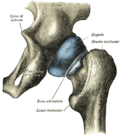 Gray's Anatomy illustration of the ilium


Ad. Transform your life with W8MD's
GLP-1 weight loss injections special from $29.99 with insurance
|
WikiMD Medical Encyclopedia |
Medical Disclaimer: WikiMD is for informational purposes only and is not a substitute for professional medical advice. Content may be inaccurate or outdated and should not be used for diagnosis or treatment. Always consult your healthcare provider for medical decisions. Verify information with trusted sources such as CDC.gov and NIH.gov. By using this site, you agree that WikiMD is not liable for any outcomes related to its content. See full disclaimer.
Credits:Most images are courtesy of Wikimedia commons, and templates, categories Wikipedia, licensed under CC BY SA or similar.
Translate this page: - East Asian
中文,
日本,
한국어,
South Asian
हिन्दी,
தமிழ்,
తెలుగు,
Urdu,
ಕನ್ನಡ,
Southeast Asian
Indonesian,
Vietnamese,
Thai,
မြန်မာဘာသာ,
বাংলা
European
español,
Deutsch,
français,
Greek,
português do Brasil,
polski,
română,
русский,
Nederlands,
norsk,
svenska,
suomi,
Italian
Middle Eastern & African
عربى,
Turkish,
Persian,
Hebrew,
Afrikaans,
isiZulu,
Kiswahili,
Other
Bulgarian,
Hungarian,
Czech,
Swedish,
മലയാളം,
मराठी,
ਪੰਜਾਬੀ,
ગુજરાતી,
Portuguese,
Ukrainian
