Colchicum

Colchicum is a genus of perennial flowering plants in the family Colchicaceae. Commonly known as autumn crocus, meadow saffron, or naked ladies, these plants are native to Europe, North Africa, and parts of Asia. The genus name is derived from the ancient region of Colchis in modern-day Georgia, where the plant was historically found.
Description
Colchicum species are herbaceous perennials that grow from corms. They produce flowers in the autumn, which are often mistaken for those of the true crocus, a member of the Iridaceae family. The flowers are typically pink, purple, or white and have six tepals. The leaves of Colchicum appear in the spring and die back by early summer, leaving the flowers to emerge "naked" in the fall, hence the common name "naked ladies."
Toxicity
All parts of the Colchicum plant contain toxic alkaloids, particularly colchicine, which can be fatal if ingested. Colchicine is a potent mitotic inhibitor and is used in medicine to treat conditions such as gout and familial Mediterranean fever. However, due to its high toxicity, it must be used with caution.
Cultivation
Colchicum species are often grown as ornamental plants in gardens. They prefer well-drained soil and a sunny or partially shaded location. The corms should be planted in late summer or early autumn, about 10 cm deep. Once established, they require minimal maintenance.
Species
There are approximately 160 species within the genus Colchicum. Some of the notable species include:
- Colchicum autumnale - Commonly known as autumn crocus or meadow saffron.
- Colchicum speciosum - Known for its large, showy flowers.
- Colchicum cilicicum - Native to Turkey and known for its vibrant pink flowers.
Uses
In addition to their ornamental value, some species of Colchicum have been used in traditional medicine. The primary medicinal compound, colchicine, is extracted from the corms and seeds of the plant. It has been used to treat gout, pericarditis, and other inflammatory conditions. However, due to its narrow therapeutic index, it is not commonly used without medical supervision.
Conservation
Some species of Colchicum are considered threatened due to habitat loss and over-collection. Conservation efforts are in place in various regions to protect these plants and their natural habitats.
Gallery
-
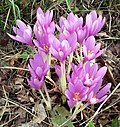 Colchicum autumnale
 -
Colchicum speciosum
-
Colchicum cilicicum

See also
References
<references group="" responsive="1"></references>
External links


Ad. Transform your life with W8MD's Budget GLP-1 injections from $29.99


W8MD offers medical weight loss programs including NYC medical weight loss and Philadelphia medical weight loss offering:
- Affordable GLP1 shots (generic and brand names) such as
- Wegovy NYC (Semaglutide)
- Zepbound NYC /
- Learn more: Budget GLP1 weight loss injections NYC & Philadelphia GLP1 weight loss shots
- Most insurances accepted
- Lowest cost GLP1 weight loss NYC such as Semaglutide starting from $29.99/week and $45.00/week (Tirzepatide) with insurance.
- Prescription weight loss NYC including:
NYC weight loss doctor appointmentsNYC weight loss doctor appointments
Start your physician weight loss journey today at our:
- NYC medical weight loss
- Philadelphia medical weight loss
- Call 718-946-5500 for NYC or 215-676-2334 for Philadelphia
Tags: Budget glp1 weight loss NYC, Zepbound NYC, Philadelphia medical weight loss, Wegovy NYC, Affordable glp1 shots Philadelphia


|
WikiMD's Wellness Encyclopedia |
| Let Food Be Thy Medicine Medicine Thy Food - Hippocrates |
Medical Disclaimer: WikiMD is not a substitute for professional medical advice. The information on WikiMD is provided as an information resource only, may be incorrect, outdated or misleading, and is not to be used or relied on for any diagnostic or treatment purposes. Please consult your health care provider before making any healthcare decisions or for guidance about a specific medical condition. WikiMD expressly disclaims responsibility, and shall have no liability, for any damages, loss, injury, or liability whatsoever suffered as a result of your reliance on the information contained in this site. By visiting this site you agree to the foregoing terms and conditions, which may from time to time be changed or supplemented by WikiMD. If you do not agree to the foregoing terms and conditions, you should not enter or use this site. See full disclaimer.
Credits:Most images are courtesy of Wikimedia commons, and templates, categories Wikipedia, licensed under CC BY SA or similar.
Translate this page: - East Asian
中文,
日本,
한국어,
South Asian
हिन्दी,
தமிழ்,
తెలుగు,
Urdu,
ಕನ್ನಡ,
Southeast Asian
Indonesian,
Vietnamese,
Thai,
မြန်မာဘာသာ,
বাংলা
European
español,
Deutsch,
français,
Greek,
português do Brasil,
polski,
română,
русский,
Nederlands,
norsk,
svenska,
suomi,
Italian
Middle Eastern & African
عربى,
Turkish,
Persian,
Hebrew,
Afrikaans,
isiZulu,
Kiswahili,
Other
Bulgarian,
Hungarian,
Czech,
Swedish,
മലയാളം,
मराठी,
ਪੰਜਾਬੀ,
ગુજરાતી,
Portuguese,
Ukrainian


