Army Medical School
Apparent Magnitude


Apparent magnitude is a measure of the brightness of a celestial object as seen from Earth. The concept of apparent magnitude is crucial in astronomy for understanding how bright objects appear in the sky, which can differ significantly from their actual luminosity due to distance and other factors.
History
The system of apparent magnitude was first developed by the ancient Greek astronomer Hipparchus in the 2nd century BCE. He classified stars into six magnitudes, with the brightest stars being first magnitude and the faintest visible stars being sixth magnitude. This system was later refined by Ptolemy and has been expanded in modern times to include objects much fainter than those visible to the naked eye.
Definition
Apparent magnitude is a logarithmic scale, where a difference of one magnitude corresponds to a brightness ratio of approximately 2.512. This scale is defined such that a decrease of 5 magnitudes corresponds to a decrease in brightness by a factor of 100. The scale is anchored such that the star Vega is defined to have an apparent magnitude of 0.
Calculation
The apparent magnitude \( m \) of an object can be calculated using the formula:
\[ m = -2.5 \log_{10} \left( \frac{F}{F_0} \right) \]
where \( F \) is the observed flux of the object and \( F_0 \) is a reference flux. This formula allows astronomers to compare the brightness of different objects in a consistent manner.
Factors Affecting Apparent Magnitude
Several factors can affect the apparent magnitude of a celestial object:
- Distance: The further away an object is, the fainter it appears, which is why apparent magnitude can differ significantly from absolute magnitude, which measures intrinsic brightness.
- Interstellar Extinction: Dust and gas between the object and the observer can absorb and scatter light, making the object appear dimmer.
- Atmospheric Effects: For observations made from Earth, the atmosphere can affect the apparent brightness of objects, especially those near the horizon.
Examples
- The Sun has an apparent magnitude of -26.74, making it the brightest object in the sky.
- The Moon has an apparent magnitude ranging from -2.5 to -12.9, depending on its phase.
- Sirius, the brightest star in the night sky, has an apparent magnitude of -1.46.
Related Concepts
- Absolute magnitude: A measure of the intrinsic brightness of a celestial object, independent of its distance from the observer.
- Luminosity: The total amount of energy emitted by a star or other astronomical object per unit time.
- Photometry: The science of measuring the flux or intensity of light from astronomical objects.
Related Pages
Gallery
-
 A star with its apparent magnitude labeled.
 -
 The Tarantula Nebula, an example of an astronomical object with a specific apparent magnitude.
 -
 Diagram illustrating the concept of apparent magnitude.
-
 Army Medical School
 -
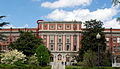 Army Medical School


Ad. Transform your health with W8MD Weight Loss, Sleep & MedSpa

Tired of being overweight?
Special offer:
Budget GLP-1 weight loss medications
- Semaglutide starting from $29.99/week and up with insurance for visit of $59.99 and up per week self pay.
- Tirzepatide starting from $45.00/week and up (dose dependent) or $69.99/week and up self pay
✔ Same-week appointments, evenings & weekends
Learn more:
- GLP-1 weight loss clinic NYC
- W8MD's NYC medical weight loss
- W8MD Philadelphia GLP-1 shots
- Philadelphia GLP-1 injections
- Affordable GLP-1 shots NYC
|
WikiMD Medical Encyclopedia |
Medical Disclaimer: WikiMD is for informational purposes only and is not a substitute for professional medical advice. Content may be inaccurate or outdated and should not be used for diagnosis or treatment. Always consult your healthcare provider for medical decisions. Verify information with trusted sources such as CDC.gov and NIH.gov. By using this site, you agree that WikiMD is not liable for any outcomes related to its content. See full disclaimer.
Credits:Most images are courtesy of Wikimedia commons, and templates, categories Wikipedia, licensed under CC BY SA or similar.
Translate this page: - East Asian
中文,
日本,
한국어,
South Asian
हिन्दी,
தமிழ்,
తెలుగు,
Urdu,
ಕನ್ನಡ,
Southeast Asian
Indonesian,
Vietnamese,
Thai,
မြန်မာဘာသာ,
বাংলা
European
español,
Deutsch,
français,
Greek,
português do Brasil,
polski,
română,
русский,
Nederlands,
norsk,
svenska,
suomi,
Italian
Middle Eastern & African
عربى,
Turkish,
Persian,
Hebrew,
Afrikaans,
isiZulu,
Kiswahili,
Other
Bulgarian,
Hungarian,
Czech,
Swedish,
മലയാളം,
मराठी,
ਪੰਜਾਬੀ,
ગુજરાતી,
Portuguese,
Ukrainian
