Pyrus pyrifolia
Species of pear native to East Asia
Pyrus pyrifolia, commonly known as the Asian pear, is a species of pear native to East Asia. It is widely cultivated for its crisp, juicy fruit, which is often consumed fresh. The fruit is known for its round shape and smooth skin, distinguishing it from the more common European pear.
Description

Pyrus pyrifolia trees are deciduous and can grow up to 10 meters in height. The leaves are ovate, with serrated edges, and the flowers are white, blooming in clusters during the spring. The fruit is typically round, with a smooth, thin skin that can range in color from yellow to brown.
Cultivation

Asian pears are cultivated extensively in East Asia, particularly in China, Japan, and Korea. The trees require a temperate climate and are often grown in orchards. They are known for their high yield and are typically harvested in late summer to early autumn.
Varieties
There are several varieties of Pyrus pyrifolia, each with distinct characteristics. Some popular varieties include:
- Kosui: Known for its sweet flavor and juicy texture.
- Nijisseiki: Also known as the "20th Century Pear," it is one of the most popular varieties in Japan.
- Shinseiki: Recognized for its crisp texture and mild flavor.

Uses
The fruit of Pyrus pyrifolia is primarily consumed fresh, appreciated for its crisp texture and sweet, juicy flavor. It is also used in cooking and baking, and can be found in various desserts and dishes in East Asian cuisine.
Cultural Significance
In many East Asian cultures, the Asian pear is a symbol of prosperity and good fortune. It is often given as a gift during festivals and celebrations.
Related pages
Gallery
-
 Pear tree in Katori City, Japan
 -
 Korean pear
 -
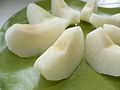 Asian pear
 -
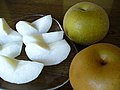 Nashi pear in Katori City
 -
 Close-up of Asian pear
 -
 Asian pear on tree


Ad. Transform your life with W8MD's
GLP-1 weight loss injections special from $29.99 with insurance
|
WikiMD Medical Encyclopedia |
Medical Disclaimer: WikiMD is for informational purposes only and is not a substitute for professional medical advice. Content may be inaccurate or outdated and should not be used for diagnosis or treatment. Always consult your healthcare provider for medical decisions. Verify information with trusted sources such as CDC.gov and NIH.gov. By using this site, you agree that WikiMD is not liable for any outcomes related to its content. See full disclaimer.
Credits:Most images are courtesy of Wikimedia commons, and templates, categories Wikipedia, licensed under CC BY SA or similar.
Translate this page: - East Asian
中文,
日本,
한국어,
South Asian
हिन्दी,
தமிழ்,
తెలుగు,
Urdu,
ಕನ್ನಡ,
Southeast Asian
Indonesian,
Vietnamese,
Thai,
မြန်မာဘာသာ,
বাংলা
European
español,
Deutsch,
français,
Greek,
português do Brasil,
polski,
română,
русский,
Nederlands,
norsk,
svenska,
suomi,
Italian
Middle Eastern & African
عربى,
Turkish,
Persian,
Hebrew,
Afrikaans,
isiZulu,
Kiswahili,
Other
Bulgarian,
Hungarian,
Czech,
Swedish,
മലയാളം,
मराठी,
ਪੰਜਾਬੀ,
ગુજરાતી,
Portuguese,
Ukrainian
