Saccharin
Saccharin is an artificial sweetener with effectively no food energy. It is about 300–400 times as sweet as sucrose but has a bitter or metallic aftertaste, especially at high concentrations. Saccharin is used to sweeten products such as drinks, candies, cookies, and medicines.
History
Saccharin was discovered in 1878 by Constantin Fahlberg, a chemist working on coal tar derivatives in Ira Remsen's laboratory at the Johns Hopkins University. Fahlberg noticed a sweet taste on his hand one evening, and connected this with the compound he had been working on that day.
Health effects
In the 1970s, studies performed on laboratory rats found an association between consumption of high doses of saccharin and the development of bladder cancer. However, further study determined that this effect was due to a mechanism that is not relevant to humans. Epidemiological studies have shown no evidence that saccharin is associated with bladder cancer in humans.
Use
Saccharin is often used together with other artificial sweeteners to compensate for each other's shortcomings. A mixture of saccharin and cyclamate, for example, is sweeter than either of its components alone.
See also
 | This medical article is a stub. You can help WikiMD by expanding the page. |
Saccharin
-
 Saccharin-Na substance photo
 -
 Süßstoff Saccharin Zucker-Museum
 -
Saccharine 300 times sweeter than sugar ad, Schulze-Berge, Koechl
-
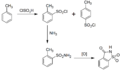 Remsen-Fahlberg synthesis of saccharin
 -
 Maumee synthesis of saccharin


Medical Disclaimer: WikiMD is for informational purposes only and is not a substitute for professional medical advice. Content may be inaccurate or outdated and should not be used for diagnosis or treatment. Always consult your healthcare provider for medical decisions. Verify information with trusted sources such as CDC.gov and NIH.gov. By using this site, you agree that WikiMD is not liable for any outcomes related to its content. See full disclaimer.
Credits:Most images are courtesy of Wikimedia commons, and templates, categories Wikipedia, licensed under CC BY SA or similar.
Translate this page: - East Asian
中文,
日本,
한국어,
South Asian
हिन्दी,
தமிழ்,
తెలుగు,
Urdu,
ಕನ್ನಡ,
Southeast Asian
Indonesian,
Vietnamese,
Thai,
မြန်မာဘာသာ,
বাংলা
European
español,
Deutsch,
français,
Greek,
português do Brasil,
polski,
română,
русский,
Nederlands,
norsk,
svenska,
suomi,
Italian
Middle Eastern & African
عربى,
Turkish,
Persian,
Hebrew,
Afrikaans,
isiZulu,
Kiswahili,
Other
Bulgarian,
Hungarian,
Czech,
Swedish,
മലയാളം,
मराठी,
ਪੰਜਾਬੀ,
ગુજરાતી,
Portuguese,
Ukrainian
