Very long-chain acyl-coenzyme A dehydrogenase deficiency
| Very long-chain acyl-coenzyme A dehydrogenase deficiency | |
|---|---|

| |
| Synonyms | VLCADD |
| Pronounce | |
| Field | |
| Symptoms | |
| Complications | |
| Onset | |
| Duration | |
| Types | |
| Causes | |
| Risks | |
| Diagnosis | |
| Differential diagnosis | |
| Prevention | |
| Treatment | |
| Medication | |
| Prognosis | |
| Frequency | |
| Deaths | |
Very long-chain acyl-coenzyme A dehydrogenase deficiency is a fatty-acid metabolism disorder which prevents the body from converting certain fats to energy, particularly during periods without food.<ref>Nancy D.,
 GeneReviews,

 Seattle (WA):University of Washington, Seattle,update 2014</ref><ref>
Reference, Genetics Home. VLCAD deficiency(link). Genetics Home Reference.
Accessed 2017-02-27.
</ref><ref>
VLCAD deficiency | Genetic and Rare Diseases Information Center (GARD) – an NCATS Program(link). rarediseases.info.nih.gov.
Accessed 2018-04-17.
</ref>
Those affected by this disorder have inadequate levels of an enzyme that breaks down a group of fats called very long-chain fatty acids. (February 2017) <ref> Reference, Genetics Home. VLCAD deficiency(link). Genetics Home Reference.
Accessed 2018-04-17.
</ref>
Signs/symptoms
Signs and symptoms can include:<ref>
Very Long Chain Acyl CoA Dehydrogenase Deficiency (LCAD)(link). {{{website}}}.
</ref>
- hypoglycemia
- lethargy
- hepatomegaly
- muscle pain
- cardiomyopathy
Genetics
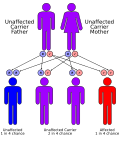
Mutations in the ACADVL gene lead to inadequate levels of an enzyme called very long-chain acyl-coenzyme A (CoA) dehydrogenase. Without this enzyme, very long-chain fatty acids from food and fats stored in the body cannot be degraded and processed. As a result, these fatty acids are not converted into energy, which can lead to characteristic signs and symptoms of this disorder, such as lethargy and hypoglycemia. Levels of very long-chain fatty acids or partially degraded fatty acids may build up in tissues and can damage the heart, liver, and muscles, causing more serious complications.
Diagnosis
Typically, initial signs and symptoms of this disorder occur during infancy and include low blood sugar (hypoglycemia), lack of energy (lethargy), and muscle weakness. There is also a high risk of complications such as liver abnormalities and life-threatening heart problems. Symptoms that begin later in childhood, adolescence, or adulthood tend to be milder and usually do not involve heart problems. Episodes of very long-chain acyl-coenzyme A dehydrogenase deficiency can be triggered by periods of fasting, illness, and exercise.
It is common for babies and children with the early and childhood types of VLCADD to have episodes of illness called metabolic crises. Some of the first symptoms of a metabolic crisis are: extreme sleepiness, behavior changes, irritable mood, poor appetite. Some of these other symptoms of VLCADD in infants may also follow: fever, nausea, diarrhea, vomiting, hypoglycemia.
Treatment
If a metabolic crisis is not treated, a child with VLCADD can develop: breathing problems, seizures, coma, sometimes leading to death.
References
<references group="" responsive="1"></references>
External links
| Inborn error of lipid metabolism: fatty-acid metabolism disorders | ||||||||||||||||||||||||
|---|---|---|---|---|---|---|---|---|---|---|---|---|---|---|---|---|---|---|---|---|---|---|---|---|
|
-
 Very long-chain acyl-coenzyme A dehydrogenase deficiency
Ad. Transform your life with W8MD's Budget GLP-1 injections from $75


W8MD offers a medical weight loss program to lose weight in Philadelphia. Our physician-supervised medical weight loss provides:
- Weight loss injections in NYC (generic and brand names):
- Zepbound / Mounjaro, Wegovy / Ozempic, Saxenda
- Most insurances accepted or discounted self-pay rates. We will obtain insurance prior authorizations if needed.
- Generic GLP1 weight loss injections from $75 for the starting dose.
- Also offer prescription weight loss medications including Phentermine, Qsymia, Diethylpropion, Contrave etc.
NYC weight loss doctor appointmentsNYC weight loss doctor appointments
Start your NYC weight loss journey today at our NYC medical weight loss and Philadelphia medical weight loss clinics.
- Call 718-946-5500 to lose weight in NYC or for medical weight loss in Philadelphia 215-676-2334.
- Tags:NYC medical weight loss, Philadelphia lose weight Zepbound NYC, Budget GLP1 weight loss injections, Wegovy Philadelphia, Wegovy NYC, Philadelphia medical weight loss, Brookly weight loss and Wegovy NYC


|
WikiMD's Wellness Encyclopedia |
| Let Food Be Thy Medicine Medicine Thy Food - Hippocrates |
Medical Disclaimer: WikiMD is not a substitute for professional medical advice. The information on WikiMD is provided as an information resource only, may be incorrect, outdated or misleading, and is not to be used or relied on for any diagnostic or treatment purposes. Please consult your health care provider before making any healthcare decisions or for guidance about a specific medical condition. WikiMD expressly disclaims responsibility, and shall have no liability, for any damages, loss, injury, or liability whatsoever suffered as a result of your reliance on the information contained in this site. By visiting this site you agree to the foregoing terms and conditions, which may from time to time be changed or supplemented by WikiMD. If you do not agree to the foregoing terms and conditions, you should not enter or use this site. See full disclaimer.
Credits:Most images are courtesy of Wikimedia commons, and templates, categories Wikipedia, licensed under CC BY SA or similar.
Translate this page: - East Asian
中文,
日本,
한국어,
South Asian
हिन्दी,
தமிழ்,
తెలుగు,
Urdu,
ಕನ್ನಡ,
Southeast Asian
Indonesian,
Vietnamese,
Thai,
မြန်မာဘာသာ,
বাংলা
European
español,
Deutsch,
français,
Greek,
português do Brasil,
polski,
română,
русский,
Nederlands,
norsk,
svenska,
suomi,
Italian
Middle Eastern & African
عربى,
Turkish,
Persian,
Hebrew,
Afrikaans,
isiZulu,
Kiswahili,
Other
Bulgarian,
Hungarian,
Czech,
Swedish,
മലയാളം,
मराठी,
ਪੰਜਾਬੀ,
ગુજરાતી,
Portuguese,
Ukrainian
