Aggressive lymphoma
Aggressive Lymphoma
Aggressive lymphoma refers to a group of fast-growing non-Hodgkin lymphomas that require prompt diagnosis and treatment. These lymphomas are characterized by rapid proliferation of malignant lymphocytes, leading to quickly enlarging lymph nodes and potential involvement of extranodal sites.
Types
Aggressive lymphomas include several subtypes, with the most common being:
Diffuse Large B-Cell Lymphoma (DLBCL)
_tonsil.jpg)
DLBCL is the most prevalent form of aggressive lymphoma, accounting for approximately 30-40% of all cases. It typically presents with rapidly enlarging masses in lymph nodes or extranodal sites such as the gastrointestinal tract, central nervous system, or bone marrow.
Burkitt Lymphoma

Burkitt lymphoma is a highly aggressive B-cell lymphoma characterized by the translocation of the MYC oncogene. It is most commonly seen in children and young adults and is associated with Epstein-Barr virus in endemic forms.
Mantle Cell Lymphoma
Mantle cell lymphoma is a rare subtype of aggressive lymphoma that often presents with widespread disease, including lymphadenopathy, splenomegaly, and bone marrow involvement. It is characterized by the overexpression of cyclin D1 due to a translocation involving chromosomes 11 and 14.
Peripheral T-Cell Lymphoma
This is a heterogeneous group of aggressive lymphomas derived from mature T-cells. They often present with systemic symptoms such as fever, weight loss, and night sweats, along with lymphadenopathy and extranodal involvement.
Diagnosis
The diagnosis of aggressive lymphoma typically involves a combination of:
- Biopsy of affected tissue, often a lymph node, to obtain a histological diagnosis.
- Immunohistochemistry and flow cytometry to determine the specific subtype of lymphoma.
- Cytogenetic and molecular studies to identify characteristic genetic abnormalities.
Treatment
Treatment of aggressive lymphoma usually involves:
- Chemotherapy, often with regimens such as R-CHOP (rituximab, cyclophosphamide, doxorubicin, vincristine, and prednisone).
- Radiation therapy in certain cases, particularly for localized disease.
- Stem cell transplantation for relapsed or refractory cases.
Prognosis
The prognosis for aggressive lymphoma varies depending on the specific subtype, stage at diagnosis, and response to treatment. DLBCL, for example, has a 5-year survival rate of approximately 60-70% with appropriate therapy.
Related Pages
Gallery
-
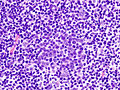 Diffuse large B-cell lymphoma in the tonsil
 -
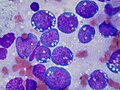 Burkitt lymphoma, touch prep, Wright stain
-
Diffuse large B-cell lymphoma in tonsil
-
Burkitt lymphoma, touch prep, Wright stain
Ad. Transform your life with W8MD's
GLP-1 weight loss injections special from $29.99 with insurance
|
WikiMD Medical Encyclopedia |
Medical Disclaimer: WikiMD is for informational purposes only and is not a substitute for professional medical advice. Content may be inaccurate or outdated and should not be used for diagnosis or treatment. Always consult your healthcare provider for medical decisions. Verify information with trusted sources such as CDC.gov and NIH.gov. By using this site, you agree that WikiMD is not liable for any outcomes related to its content. See full disclaimer.
Credits:Most images are courtesy of Wikimedia commons, and templates, categories Wikipedia, licensed under CC BY SA or similar.
Translate this page: - East Asian
中文,
日本,
한국어,
South Asian
हिन्दी,
தமிழ்,
తెలుగు,
Urdu,
ಕನ್ನಡ,
Southeast Asian
Indonesian,
Vietnamese,
Thai,
မြန်မာဘာသာ,
বাংলা
European
español,
Deutsch,
français,
Greek,
português do Brasil,
polski,
română,
русский,
Nederlands,
norsk,
svenska,
suomi,
Italian
Middle Eastern & African
عربى,
Turkish,
Persian,
Hebrew,
Afrikaans,
isiZulu,
Kiswahili,
Other
Bulgarian,
Hungarian,
Czech,
Swedish,
മലയാളം,
मराठी,
ਪੰਜਾਬੀ,
ગુજરાતી,
Portuguese,
Ukrainian
