Clement of Alexandria
Clement of Alexandria (c. 150 – c. 215 AD) was an early Christian theologian and philosopher who taught at the Catechetical School of Alexandria. He was one of the most prominent figures in early Christianity and played a significant role in the development of Christian thought.
Early Life and Education
Clement was born in Athens, Greece, around 150 AD. He was educated in the classical Greek tradition and was well-versed in philosophy, literature, and rhetoric. His education laid the foundation for his later work in integrating Christian theology with Greek philosophy.
Career
Clement moved to Alexandria, where he became a student of Pantaenus, the head of the Catechetical School. After Pantaenus's death, Clement succeeded him as the head of the school. Under his leadership, the school became a center for Christian learning and attracted students from across the Roman Empire.
Works
Clement's most notable works include:
- Protrepticus (Exhortation to the Greeks) - A work aimed at converting pagans to Christianity by demonstrating the superiority of Christian teachings over pagan beliefs.
- Paedagogus (The Instructor) - A treatise on Christian ethics and moral instruction, emphasizing the role of Christ as the divine teacher.
- Stromata (Miscellanies) - A collection of writings on various topics, blending philosophy, theology, and ethics.
Influence and Legacy
Clement's work was instrumental in the development of Christian apologetics and the integration of Greek philosophy into Christian doctrine. His writings influenced later theologians such as Origen and Athanasius of Alexandria.
Clement's approach to theology was characterized by his belief in the compatibility of faith and reason. He argued that philosophy was a "preparatory discipline" for understanding Christian truth.
Death
Clement is believed to have died around 215 AD in Jerusalem, although the exact circumstances of his death are not well-documented.
See Also
References
- Henry,
 The Early Church,

 Penguin Books,
 1967,
- Justo L.,
 The Story of Christianity,

 HarperCollins,
 1984,
External Links
- Catholic Encyclopedia: Clement of Alexandria
- Stanford Encyclopedia of Philosophy: Clement of Alexandria
-
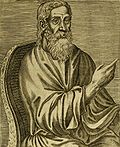 Clement Alexandrin
 -
 Klementos Alexandreos ta heuriskomena
 -
 Orfeo (epoca romana)
 -
 Jesus Christ from Hagia Sophia
 -
 Alpine flora Logan Pass
 -
 Carton de vitrail de la chapelle Saint Ferdinand Saint Clément d'Alexandrie

_-_Foto_G._Dall%27Orto.jpg)


Ad. Transform your life with W8MD's
GLP-1 weight loss injections special from $29.99 with insurance
|
WikiMD Medical Encyclopedia |
Medical Disclaimer: WikiMD is for informational purposes only and is not a substitute for professional medical advice. Content may be inaccurate or outdated and should not be used for diagnosis or treatment. Always consult your healthcare provider for medical decisions. Verify information with trusted sources such as CDC.gov and NIH.gov. By using this site, you agree that WikiMD is not liable for any outcomes related to its content. See full disclaimer.
Credits:Most images are courtesy of Wikimedia commons, and templates, categories Wikipedia, licensed under CC BY SA or similar.
Translate this page: - East Asian
中文,
日本,
한국어,
South Asian
हिन्दी,
தமிழ்,
తెలుగు,
Urdu,
ಕನ್ನಡ,
Southeast Asian
Indonesian,
Vietnamese,
Thai,
မြန်မာဘာသာ,
বাংলা
European
español,
Deutsch,
français,
Greek,
português do Brasil,
polski,
română,
русский,
Nederlands,
norsk,
svenska,
suomi,
Italian
Middle Eastern & African
عربى,
Turkish,
Persian,
Hebrew,
Afrikaans,
isiZulu,
Kiswahili,
Other
Bulgarian,
Hungarian,
Czech,
Swedish,
മലയാളം,
मराठी,
ਪੰਜਾਬੀ,
ગુજરાતી,
Portuguese,
Ukrainian
