Biliverdin reductase
Enzyme involved in heme metabolism
Biliverdin reductase
Biliverdin reductase is an enzyme that plays a crucial role in the heme catabolic pathway. It catalyzes the conversion of biliverdin to bilirubin, a process that is essential for the clearance of heme from the body. This reaction is an important step in the metabolism of heme, which is derived from the breakdown of hemoglobin in red blood cells.
Function
Biliverdin reductase is responsible for the reduction of biliverdin IXα to bilirubin IXα. This reaction involves the transfer of electrons from NADPH or NADH to biliverdin, resulting in the production of bilirubin. The enzyme is highly specific for the IXα isomer of biliverdin, which is the predominant form produced during heme degradation.
The conversion of biliverdin to bilirubin is significant because bilirubin is a potent antioxidant. It helps to protect cells from oxidative damage by scavenging free radicals. Additionally, bilirubin is transported to the liver, where it is conjugated and excreted in bile, thus facilitating the removal of heme-derived waste products from the body.
Structure
Biliverdin reductase is a cytosolic enzyme that is widely expressed in various tissues. It is a monomeric protein with a molecular weight of approximately 34 kDa. The enzyme contains a binding site for NADPH or NADH, which is necessary for its reductase activity.
Clinical significance
Dysfunction or deficiency of biliverdin reductase can lead to an accumulation of biliverdin, which may result in jaundice, a condition characterized by yellowing of the skin and eyes due to elevated levels of bilirubin in the blood. Understanding the role of biliverdin reductase is important in the context of liver disease, hemolytic anemia, and other conditions that affect heme metabolism.
Research
Recent studies have explored the potential therapeutic applications of biliverdin reductase. Its role in modulating oxidative stress and inflammation has made it a target for research in conditions such as cardiovascular disease, neurodegenerative disorders, and cancer.
Also see
| Enzymes | ||||||||||
|---|---|---|---|---|---|---|---|---|---|---|
|
-
 1hdo
1hdo -
 BLVRA 2H63
 -
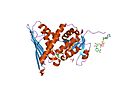 PDB 1lc3 EBI
 -
 BVR mechanism


Ad. Transform your health with W8MD Weight Loss, Sleep & MedSpa

Tired of being overweight?
Special offer:
Budget GLP-1 weight loss medications
- Semaglutide starting from $29.99/week and up with insurance for visit of $59.99 and up per week self pay.
- Tirzepatide starting from $45.00/week and up (dose dependent) or $69.99/week and up self pay
✔ Same-week appointments, evenings & weekends
Learn more:
- GLP-1 weight loss clinic NYC
- W8MD's NYC medical weight loss
- W8MD Philadelphia GLP-1 shots
- Philadelphia GLP-1 injections
- Affordable GLP-1 shots NYC
|
WikiMD Medical Encyclopedia |
Medical Disclaimer: WikiMD is for informational purposes only and is not a substitute for professional medical advice. Content may be inaccurate or outdated and should not be used for diagnosis or treatment. Always consult your healthcare provider for medical decisions. Verify information with trusted sources such as CDC.gov and NIH.gov. By using this site, you agree that WikiMD is not liable for any outcomes related to its content. See full disclaimer.
Credits:Most images are courtesy of Wikimedia commons, and templates, categories Wikipedia, licensed under CC BY SA or similar.
Translate this page: - East Asian
中文,
日本,
한국어,
South Asian
हिन्दी,
தமிழ்,
తెలుగు,
Urdu,
ಕನ್ನಡ,
Southeast Asian
Indonesian,
Vietnamese,
Thai,
မြန်မာဘာသာ,
বাংলা
European
español,
Deutsch,
français,
Greek,
português do Brasil,
polski,
română,
русский,
Nederlands,
norsk,
svenska,
suomi,
Italian
Middle Eastern & African
عربى,
Turkish,
Persian,
Hebrew,
Afrikaans,
isiZulu,
Kiswahili,
Other
Bulgarian,
Hungarian,
Czech,
Swedish,
മലയാളം,
मराठी,
ਪੰਜਾਬੀ,
ગુજરાતી,
Portuguese,
Ukrainian
