Carbon suboxide

Carbon suboxide, or C3O2, is an oxide of carbon that is a colorless gas with a sharp odor. It is interesting for its unusual structure and for being one of the simplest molecules that exhibits polymerization. Carbon suboxide is also notable for its role in the chemistry of the atmosphere of Mars, as well as for its use in organic synthesis.
Structure and Properties
Carbon suboxide is composed of three carbon atoms and two oxygen atoms, with the molecular formula C3O2. The structure of carbon suboxide can be described as a linear chain of three carbon atoms with two terminal oxygen atoms. This molecule is a cumulene, meaning it contains a series of double bonds that alternate with single bonds. Specifically, its structure can be represented as O=C=C=C=O, which shows the cumulenic nature of the molecule.
The molecule is of interest due to its electronic structure and its ability to polymerize into larger networks. Carbon suboxide's polymerization can lead to the formation of various types of polymers, which have potential applications in materials science.
Synthesis
Carbon suboxide can be synthesized through the dehydration of malonic acid (C3H4O4) with phosphorus pentoxide (P2O5) acting as the dehydrating agent. The reaction proceeds through the removal of water (H2O) from malonic acid, leading to the formation of C3O2.
Reactions and Uses
Despite its instability, carbon suboxide has been studied for its reactivity and potential uses in organic synthesis. It can act as a building block for the synthesis of more complex organic compounds. Additionally, carbon suboxide has been investigated for its role in the atmosphere of Mars, where it could participate in chemical reactions that contribute to the planet's climate and potential for supporting life.
Safety and Precautions
Carbon suboxide is a reactive gas and should be handled with care in a controlled environment. It can pose risks due to its reactivity and the potential for polymerization under certain conditions.
In Popular Culture
While not widely known in popular culture, carbon suboxide's unique properties and potential applications in science and technology make it a subject of interest among chemists and researchers.

-
 2D dimensions of Carbon suboxide
 -
 3D van der Waals model of Carbon suboxide
 -
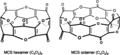 Macrocyclic polymers of Carbon suboxide
 -
 Dative bonding in Carbon suboxide


Ad. Transform your health with W8MD Weight Loss, Sleep & MedSpa

Tired of being overweight?
Get started with evidence based, physician-supervised
affordable GLP-1 weight loss injections
Now available in New York City and Philadelphia:
- Semaglutide starting from $59.99/week and up
- Tirzepatide starting from $69.99/week and up (dose dependent)
✔ Evidence-based medical weight loss ✔ Insurance-friendly visits available ✔ Same-week appointments, evenings & weekends
Learn more:
Start your transformation today with W8MD weight loss centers.
|
WikiMD Medical Encyclopedia |
Medical Disclaimer: WikiMD is for informational purposes only and is not a substitute for professional medical advice. Content may be inaccurate or outdated and should not be used for diagnosis or treatment. Always consult your healthcare provider for medical decisions. Verify information with trusted sources such as CDC.gov and NIH.gov. By using this site, you agree that WikiMD is not liable for any outcomes related to its content. See full disclaimer.
Credits:Most images are courtesy of Wikimedia commons, and templates, categories Wikipedia, licensed under CC BY SA or similar.
Translate this page: - East Asian
中文,
日本,
한국어,
South Asian
हिन्दी,
தமிழ்,
తెలుగు,
Urdu,
ಕನ್ನಡ,
Southeast Asian
Indonesian,
Vietnamese,
Thai,
မြန်မာဘာသာ,
বাংলা
European
español,
Deutsch,
français,
Greek,
português do Brasil,
polski,
română,
русский,
Nederlands,
norsk,
svenska,
suomi,
Italian
Middle Eastern & African
عربى,
Turkish,
Persian,
Hebrew,
Afrikaans,
isiZulu,
Kiswahili,
Other
Bulgarian,
Hungarian,
Czech,
Swedish,
മലയാളം,
मराठी,
ਪੰਜਾਬੀ,
ગુજરાતી,
Portuguese,
Ukrainian
