Dorsal cochlear nucleus
Dorsal Cochlear Nucleus'
The Dorsal Cochlear Nucleus (DCN) is a critical auditory structure in the brainstem that plays a significant role in the processing of sound within the central auditory system. It is one of the two primary nuclei found in the cochlear nucleus, the other being the Ventral Cochlear Nucleus (VCN). The DCN is notable for its complex neuroanatomy and involvement in various auditory functions, including sound localization, frequency resolution, and the integration of auditory with non-auditory information.
Anatomy
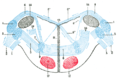
The Dorsal Cochlear Nucleus is located at the junction of the pons and medulla oblongata, sitting atop the inferior cerebellar peduncle. It receives direct input from the cochlea via the auditory nerve, specifically from the cochlear nerve's type I fibers, which primarily innervate inner hair cells. The DCN's structure is distinguished by its layered architecture, which includes the fusiform cell layer, the molecular layer, and the polymorphic layer. Each layer contains specific types of neurons and plays a distinct role in auditory processing.
Function
The primary function of the DCN is to process and modify auditory information received from the cochlea before it is transmitted to higher centers in the brain. The DCN is involved in several key auditory processing tasks:
- Sound Localization: The DCN contributes to the detection of sound location, particularly in the vertical plane, by analyzing the spectral cues created by the interaction of sound with the outer ear.
- Frequency Resolution: It plays a role in the separation and analysis of sound frequencies, which is essential for understanding complex sounds and speech.
- Integration of Auditory and Non-auditory Information: The DCN receives inputs from other sensory systems, such as the somatosensory system, and integrates this information with auditory signals. This integration is thought to play a role in the brain's ability to focus on relevant sounds in noisy environments.
Pathophysiology
Alterations in the function or structure of the DCN can lead to various auditory disorders. For example, damage to the DCN has been implicated in the development of tinnitus, a condition characterized by the perception of sound without an external source. Additionally, the DCN's role in sound localization and frequency resolution means that its dysfunction can contribute to difficulties in understanding speech, especially in noisy environments.
Research and Clinical Significance
Understanding the function and pathology of the Dorsal Cochlear Nucleus is crucial for developing treatments for hearing impairments and auditory processing disorders. Research into the DCN also contributes to the broader field of neuroscience, offering insights into how the brain processes sensory information and integrates signals from different sensory modalities.
See Also

-
 Dorsal cochlear nucleus
 -
 Dorsal cochlear nucleus


Ad. Transform your health with W8MD Weight Loss, Sleep & MedSpa

Tired of being overweight?
Get started with evidence based, physician-supervised
affordable GLP-1 weight loss injections
Now available in New York City and Philadelphia:
- Semaglutide starting from $59.99/week and up
- Tirzepatide starting from $69.99/week and up (dose dependent)
✔ Evidence-based medical weight loss ✔ Insurance-friendly visits available ✔ Same-week appointments, evenings & weekends
Learn more:
Start your transformation today with W8MD weight loss centers.
|
WikiMD Medical Encyclopedia |
Medical Disclaimer: WikiMD is for informational purposes only and is not a substitute for professional medical advice. Content may be inaccurate or outdated and should not be used for diagnosis or treatment. Always consult your healthcare provider for medical decisions. Verify information with trusted sources such as CDC.gov and NIH.gov. By using this site, you agree that WikiMD is not liable for any outcomes related to its content. See full disclaimer.
Credits:Most images are courtesy of Wikimedia commons, and templates, categories Wikipedia, licensed under CC BY SA or similar.
Translate this page: - East Asian
中文,
日本,
한국어,
South Asian
हिन्दी,
தமிழ்,
తెలుగు,
Urdu,
ಕನ್ನಡ,
Southeast Asian
Indonesian,
Vietnamese,
Thai,
မြန်မာဘာသာ,
বাংলা
European
español,
Deutsch,
français,
Greek,
português do Brasil,
polski,
română,
русский,
Nederlands,
norsk,
svenska,
suomi,
Italian
Middle Eastern & African
عربى,
Turkish,
Persian,
Hebrew,
Afrikaans,
isiZulu,
Kiswahili,
Other
Bulgarian,
Hungarian,
Czech,
Swedish,
മലയാളം,
मराठी,
ਪੰਜਾਬੀ,
ગુજરાતી,
Portuguese,
Ukrainian
