Laplace's method
Laplace's method is a mathematical technique used to approximate integrals, particularly those that are difficult or impossible to compute exactly. It is named after Pierre-Simon Laplace, a French mathematician and astronomer who made significant contributions to statistics, mathematics, and celestial mechanics. Laplace's method is especially useful in the field of statistics, applied mathematics, and theoretical physics, where it is often applied to problems in statistical mechanics, quantum mechanics, and Bayesian statistics.
Overview
The essence of Laplace's method lies in approximating the integral of a function by focusing on the region around the point where the function reaches its maximum value. This is based on the observation that, in many cases, the contributions to the integral from regions far from the maximum are negligible. The method is particularly effective for integrals of the form:
\[ \int e^{Mf(x)}\,dx \]
where \(M\) is a large parameter. The function \(f(x)\) is assumed to have a unique maximum at a point \(x_0\). Laplace's method then approximates the integral by expanding \(f(x)\) in a Taylor series around \(x_0\) and retaining only the leading terms.
Application
Laplace's method has wide-ranging applications across various disciplines. In Bayesian statistics, it is used to approximate posterior distributions in Bayesian inference. In theoretical physics, it helps in evaluating path integrals and partition functions. Its utility in applied mathematics includes solving differential equations and approximating solutions to complex problems.
Mathematical Formulation
To apply Laplace's method, one typically follows these steps: 1. Identify the point \(x_0\) where the function \(f(x)\) attains its maximum. 2. Expand \(f(x)\) in a Taylor series around \(x_0\), usually retaining terms up to the second order. 3. Approximate the integral by evaluating the Gaussian integral that results from the Taylor series expansion.
The approximation becomes increasingly accurate as \(M\) becomes larger, making Laplace's method a powerful tool for dealing with high-dimensional integrals in particular.
Limitations
While Laplace's method is a powerful approximation technique, it has limitations. It is most effective when the function \(f(x)\) has a single, well-defined maximum. The method may not provide accurate approximations for functions with multiple maxima or for integrals over infinite domains where the maximum does not exist or is not well-defined.
See Also
References
<references/>

This article is a mathematics-related stub. You can help WikiMD by expanding it!

This article is a statistics-related stub. You can help WikiMD by expanding it!
-
 Laplace's method illustration
 -
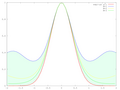 Laplace's method with different M
 -
 Upper limit function m(x) for Laplace's method


.gif)
Ad. Transform your life with W8MD's
GLP-1 weight loss injections special from $29.99 with insurance
|
WikiMD Medical Encyclopedia |
Medical Disclaimer: WikiMD is for informational purposes only and is not a substitute for professional medical advice. Content may be inaccurate or outdated and should not be used for diagnosis or treatment. Always consult your healthcare provider for medical decisions. Verify information with trusted sources such as CDC.gov and NIH.gov. By using this site, you agree that WikiMD is not liable for any outcomes related to its content. See full disclaimer.
Credits:Most images are courtesy of Wikimedia commons, and templates, categories Wikipedia, licensed under CC BY SA or similar.
Translate this page: - East Asian
中文,
日本,
한국어,
South Asian
हिन्दी,
தமிழ்,
తెలుగు,
Urdu,
ಕನ್ನಡ,
Southeast Asian
Indonesian,
Vietnamese,
Thai,
မြန်မာဘာသာ,
বাংলা
European
español,
Deutsch,
français,
Greek,
português do Brasil,
polski,
română,
русский,
Nederlands,
norsk,
svenska,
suomi,
Italian
Middle Eastern & African
عربى,
Turkish,
Persian,
Hebrew,
Afrikaans,
isiZulu,
Kiswahili,
Other
Bulgarian,
Hungarian,
Czech,
Swedish,
മലയാളം,
मराठी,
ਪੰਜਾਬੀ,
ગુજરાતી,
Portuguese,
Ukrainian
