Brazo de Mercedes
Brazo de Mercedes (literally "Arm of Mercedes") is a traditional Filipino dessert, a type of roll cake made from a sheet of soft meringue with custard filling. The dessert is well-known for its creamy and fluffy texture, and is often served during special occasions and festivities in the Philippines.
History
The origins of Brazo de Mercedes are not well-documented, but it is believed to have been introduced during the Spanish colonial period, as its name is Spanish for "Mercedes' arm". The dessert is thought to have been named after a woman named Mercedes who was known for her culinary skills.
Preparation
The preparation of Brazo de Mercedes involves two main components: the meringue and the custard filling. The meringue is made by beating egg whites until they form stiff peaks, then gradually adding granulated sugar and cream of tartar. The mixture is spread onto a baking sheet and baked until it is light brown.
The custard filling is made by combining egg yolks, condensed milk, and vanilla extract in a saucepan and cooking it over low heat until it thickens. The custard is then spread over the baked meringue, which is rolled to form a log shape. The dessert is typically dusted with confectioner's sugar before serving.
Variations
There are several variations of Brazo de Mercedes, including ones that incorporate different flavors such as ube, pandan, and mango. Some versions also include a layer of cake or sponge cake in addition to the meringue and custard.
Cultural significance
Brazo de Mercedes is a popular dessert in the Philippines and is often served during special occasions such as birthdays, weddings, and holidays. It is also commonly found in bakeries and dessert shops throughout the country.
_-_grilled_saba_bananas_-_01.jpg)
This article is a Filipino cuisine–related stub. You can help WikiMD by expanding it!

-
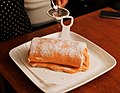 Brazo de Mercedes
 -
 Brazo de Mercedes


Ad. Transform your life with W8MD's
GLP-1 weight loss injections special from $29.99 with insurance
|
WikiMD Medical Encyclopedia |
Medical Disclaimer: WikiMD is for informational purposes only and is not a substitute for professional medical advice. Content may be inaccurate or outdated and should not be used for diagnosis or treatment. Always consult your healthcare provider for medical decisions. Verify information with trusted sources such as CDC.gov and NIH.gov. By using this site, you agree that WikiMD is not liable for any outcomes related to its content. See full disclaimer.
Credits:Most images are courtesy of Wikimedia commons, and templates, categories Wikipedia, licensed under CC BY SA or similar.
Translate this page: - East Asian
中文,
日本,
한국어,
South Asian
हिन्दी,
தமிழ்,
తెలుగు,
Urdu,
ಕನ್ನಡ,
Southeast Asian
Indonesian,
Vietnamese,
Thai,
မြန်မာဘာသာ,
বাংলা
European
español,
Deutsch,
français,
Greek,
português do Brasil,
polski,
română,
русский,
Nederlands,
norsk,
svenska,
suomi,
Italian
Middle Eastern & African
عربى,
Turkish,
Persian,
Hebrew,
Afrikaans,
isiZulu,
Kiswahili,
Other
Bulgarian,
Hungarian,
Czech,
Swedish,
മലയാളം,
मराठी,
ਪੰਜਾਬੀ,
ગુજરાતી,
Portuguese,
Ukrainian
