Morus rubra
Morus rubra, commonly known as the Red Mulberry, is a species of mulberry native to eastern and central North America. It is found from Ontario, Minnesota, and Vermont south to southern Florida, and west as far as southeastern South Dakota, Nebraska, Kansas, and central Texas.
Description
Morus rubra is a deciduous tree, growing to 10–15 m tall, rarely 20 m. The leaves are 10–20 cm long by 6–12 cm broad - up to 23 cm long on vigorous young trees, downy on the underside, the upper surface rough with very short, stiff hairs. The flowers are 1–1.5 cm long; the fruit is 2–3 cm long, in wild trees often deep red, pink in some cultivated plants.
Habitat and Distribution
Morus rubra is found in rich woods, bottom lands, and along fencerows. It is often found in association with other hardwoods such as Quercus rubra and Acer rubrum. The species is threatened by the invasive species Morus alba (White Mulberry), which hybridizes with it.
Uses
The fruit of Morus rubra is edible and can be eaten raw or cooked. It is also used in pies, tarts, and wines. The wood is used for fence posts and furniture. The leaves are used as fodder for silkworms.
Conservation
Morus rubra is listed as a species of concern in several U.S. states. Efforts are being made to control the spread of Morus alba and to preserve pure stands of Morus rubra.
See also

-
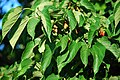 Morus Rubra 9
 -
 Morus rubra 250389
 -
 Morus rubra Nana kz1
 -
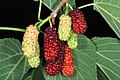 Morus Rubra 2


Ad. Transform your life with W8MD's
GLP-1 weight loss injections special from $29.99 with insurance
|
WikiMD Medical Encyclopedia |
Medical Disclaimer: WikiMD is for informational purposes only and is not a substitute for professional medical advice. Content may be inaccurate or outdated and should not be used for diagnosis or treatment. Always consult your healthcare provider for medical decisions. Verify information with trusted sources such as CDC.gov and NIH.gov. By using this site, you agree that WikiMD is not liable for any outcomes related to its content. See full disclaimer.
Credits:Most images are courtesy of Wikimedia commons, and templates, categories Wikipedia, licensed under CC BY SA or similar.
Translate this page: - East Asian
中文,
日本,
한국어,
South Asian
हिन्दी,
தமிழ்,
తెలుగు,
Urdu,
ಕನ್ನಡ,
Southeast Asian
Indonesian,
Vietnamese,
Thai,
မြန်မာဘာသာ,
বাংলা
European
español,
Deutsch,
français,
Greek,
português do Brasil,
polski,
română,
русский,
Nederlands,
norsk,
svenska,
suomi,
Italian
Middle Eastern & African
عربى,
Turkish,
Persian,
Hebrew,
Afrikaans,
isiZulu,
Kiswahili,
Other
Bulgarian,
Hungarian,
Czech,
Swedish,
മലയാളം,
मराठी,
ਪੰਜਾਬੀ,
ગુજરાતી,
Portuguese,
Ukrainian
