Atomic nucleus
Atomic Nucleus
The atomic nucleus is the small, dense region consisting of protons and neutrons at the center of an atom. Discovered in 1911 by Ernest Rutherford, the atomic nucleus is held together by the strong force, one of the four fundamental forces of nature.
Structure
The atomic nucleus is composed of two kinds of particles: protons and neutrons, collectively known as nucleons. Protons carry a positive electric charge, while neutrons are electrically neutral. The number of protons in the nucleus determines the atomic number and identifies the chemical element. The total number of protons and neutrons in the nucleus defines an atom's mass number.
Properties
The atomic nucleus is extremely dense and accounts for nearly all the mass of an atom. Despite its small size, the nucleus contains over 99.9% of an atom's mass but occupies only about one ten-thousandth of the total volume of the atom.
Nuclear Forces
The atomic nucleus is held together by the strong force, which overcomes the electromagnetic force that would otherwise cause the positively charged protons to repel each other. The strong force binds protons and neutrons together in the nucleus.
Nuclear Reactions
Changes in the atomic nucleus can result in nuclear reactions, including nuclear fission, in which a nucleus splits into two or more smaller nuclei, and nuclear fusion, in which two or more smaller nuclei combine to form a larger nucleus. These reactions release a large amount of energy, which is the basis for nuclear power and nuclear weapons.
See Also
References
<references />

-
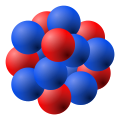 Diagram of an atomic nucleus
 -
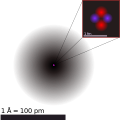 Quantum mechanical model of a helium atom
 -
 Liquid drop model of the atomic nucleus


Ad. Transform your life with W8MD's
GLP-1 weight loss injections special from $29.99 with insurance
|
WikiMD Medical Encyclopedia |
Medical Disclaimer: WikiMD is for informational purposes only and is not a substitute for professional medical advice. Content may be inaccurate or outdated and should not be used for diagnosis or treatment. Always consult your healthcare provider for medical decisions. Verify information with trusted sources such as CDC.gov and NIH.gov. By using this site, you agree that WikiMD is not liable for any outcomes related to its content. See full disclaimer.
Credits:Most images are courtesy of Wikimedia commons, and templates, categories Wikipedia, licensed under CC BY SA or similar.
Translate this page: - East Asian
中文,
日本,
한국어,
South Asian
हिन्दी,
தமிழ்,
తెలుగు,
Urdu,
ಕನ್ನಡ,
Southeast Asian
Indonesian,
Vietnamese,
Thai,
မြန်မာဘာသာ,
বাংলা
European
español,
Deutsch,
français,
Greek,
português do Brasil,
polski,
română,
русский,
Nederlands,
norsk,
svenska,
suomi,
Italian
Middle Eastern & African
عربى,
Turkish,
Persian,
Hebrew,
Afrikaans,
isiZulu,
Kiswahili,
Other
Bulgarian,
Hungarian,
Czech,
Swedish,
മലയാളം,
मराठी,
ਪੰਜਾਬੀ,
ગુજરાતી,
Portuguese,
Ukrainian
