Manchuria
Manchuria is a region in East Asia. Depending on the definition of its extent, Manchuria can either refer to a region falling entirely within China, or a larger region today divided between Northeast China and Russia's Far East. The Chinese definition refers to the three provinces of Heilongjiang, Jilin, and Liaoning, but the international definition also includes the eastern part of Inner Mongolia.
History
Manchuria has a long history of conquest and power struggles among various ethnic groups, including the Mohe, Jurchen, Mongols, and Manchu. The region was the homeland of the Manchu people who established the Qing dynasty, which ruled China from 1644 to 1912.
Geography
Manchuria is a region defined by its geography, with high mountains forming its eastern and southern boundaries. The region is also known for its vast forests and rich mineral resources.
Economy
Manchuria's economy is heavily dependent on its vast natural resources. The region is one of the world's largest suppliers of raw materials, including coal, oil, and iron ore. It also has a significant agricultural sector, producing crops such as soybeans, corn, and wheat.
Culture
Manchuria is home to a diverse range of cultures, with influences from the Manchu, Han Chinese, Korean, Mongol, and Russian cultures. The region is known for its traditional music, dance, and art, as well as its unique cuisine.
See also
 | |
|---|---|
 |
 |
-
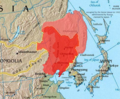 Manchuria
 -
 Amurrivermap
 -
 John-Tallis-1851-Tibet-Mongolia-and-Manchuria-NE
 -
 EB1911 Manchuria
 -
 Manchukuo Railmap
 -
 Ming divisions
 -
 The Americana - a universal reference library
 -
 Climate Map for Manchuria-Northeast China
 -
 China Railways passenger train K1452 on Binsui railway
 -
 Ussuriysk Stone Tortoise
 -
 Three Kingdoms of Korea Map
 -
 Yuan dynasty and Manchuria


_(14763639145).jpg)


Ad. Transform your life with W8MD's
GLP-1 weight loss injections special from $29.99 with insurance
|
WikiMD Medical Encyclopedia |
Medical Disclaimer: WikiMD is for informational purposes only and is not a substitute for professional medical advice. Content may be inaccurate or outdated and should not be used for diagnosis or treatment. Always consult your healthcare provider for medical decisions. Verify information with trusted sources such as CDC.gov and NIH.gov. By using this site, you agree that WikiMD is not liable for any outcomes related to its content. See full disclaimer.
Credits:Most images are courtesy of Wikimedia commons, and templates, categories Wikipedia, licensed under CC BY SA or similar.
Translate this page: - East Asian
中文,
日本,
한국어,
South Asian
हिन्दी,
தமிழ்,
తెలుగు,
Urdu,
ಕನ್ನಡ,
Southeast Asian
Indonesian,
Vietnamese,
Thai,
မြန်မာဘာသာ,
বাংলা
European
español,
Deutsch,
français,
Greek,
português do Brasil,
polski,
română,
русский,
Nederlands,
norsk,
svenska,
suomi,
Italian
Middle Eastern & African
عربى,
Turkish,
Persian,
Hebrew,
Afrikaans,
isiZulu,
Kiswahili,
Other
Bulgarian,
Hungarian,
Czech,
Swedish,
മലയാളം,
मराठी,
ਪੰਜਾਬੀ,
ગુજરાતી,
Portuguese,
Ukrainian
