Craniopagus twins: Difference between revisions
CSV import |
CSV import |
||
| Line 1: | Line 1: | ||
{{SI}} | |||
{{Infobox medical condition | |||
| name = Craniopagus twins | |||
| image = [[File:CraniopagusTwins.jpg|250px]] | |||
| caption = Illustration of craniopagus twins | |||
| field = [[Pediatrics]], [[Neurosurgery]] | |||
| symptoms = [[Conjoined twins]] with fused [[skull]]s | |||
| complications = [[Neurological disorder]]s, [[hydrocephalus]], [[seizures]] | |||
| onset = [[Congenital disorder|Congenital]] | |||
| duration = Lifelong | |||
| causes = [[Embryology|Embryological]] development error | |||
| risks = [[Pregnancy]] with [[monozygotic twins]] | |||
| diagnosis = [[Prenatal diagnosis|Prenatal]] [[ultrasound]], [[MRI]] | |||
| differential = Other forms of [[conjoined twins]] | |||
| treatment = [[Surgical separation]], [[supportive care]] | |||
| prognosis = Varies; depends on extent of fusion and surgical success | |||
| frequency = 1 in 2.5 million live births | |||
| deaths = High mortality rate without intervention | |||
}} | |||
'''Craniopagus twins''' are a rare phenomenon in which two [[twins]] are conjoined at the head. This condition occurs in approximately 1 in 2.5 million births, making it an extremely rare occurrence. The term "craniopagus" is derived from the Greek words "cranio" meaning skull, and "pagus" meaning fixed. Thus, craniopagus twins are twins who are 'fixed at the skull'. | '''Craniopagus twins''' are a rare phenomenon in which two [[twins]] are conjoined at the head. This condition occurs in approximately 1 in 2.5 million births, making it an extremely rare occurrence. The term "craniopagus" is derived from the Greek words "cranio" meaning skull, and "pagus" meaning fixed. Thus, craniopagus twins are twins who are 'fixed at the skull'. | ||
== Anatomy and Physiology == | == Anatomy and Physiology == | ||
Craniopagus twins share a common [[skull]], but the extent of their shared brain tissue can vary greatly. In some cases, the twins may share a significant portion of their [[brain]], while in others, they may share only a small amount of tissue. The shared brain tissue can lead to shared consciousness, sensations, and even thoughts, although this is not always the case. | Craniopagus twins share a common [[skull]], but the extent of their shared brain tissue can vary greatly. In some cases, the twins may share a significant portion of their [[brain]], while in others, they may share only a small amount of tissue. The shared brain tissue can lead to shared consciousness, sensations, and even thoughts, although this is not always the case. | ||
== Causes == | == Causes == | ||
The exact cause of craniopagus twins is unknown, but it is believed to be due to an incomplete separation of the [[embryo]] during the early stages of [[pregnancy]]. This incomplete separation results in the twins being physically joined at the head. | The exact cause of craniopagus twins is unknown, but it is believed to be due to an incomplete separation of the [[embryo]] during the early stages of [[pregnancy]]. This incomplete separation results in the twins being physically joined at the head. | ||
== Diagnosis and Treatment == | == Diagnosis and Treatment == | ||
Diagnosis of craniopagus twins is typically made during pregnancy through the use of [[ultrasound]] imaging. Once diagnosed, a team of specialists, including [[neurosurgeons]], [[plastic surgeons]], and [[pediatricians]], work together to plan for the birth and subsequent care of the twins. | Diagnosis of craniopagus twins is typically made during pregnancy through the use of [[ultrasound]] imaging. Once diagnosed, a team of specialists, including [[neurosurgeons]], [[plastic surgeons]], and [[pediatricians]], work together to plan for the birth and subsequent care of the twins. | ||
Treatment for craniopagus twins often involves surgery to separate the twins. However, this is a complex and risky procedure due to the shared brain tissue and blood vessels. The goal of surgery is to separate the twins while minimizing damage to their brains. | Treatment for craniopagus twins often involves surgery to separate the twins. However, this is a complex and risky procedure due to the shared brain tissue and blood vessels. The goal of surgery is to separate the twins while minimizing damage to their brains. | ||
== Prognosis == | == Prognosis == | ||
The prognosis for craniopagus twins varies greatly depending on the extent of their shared brain tissue and the success of surgical separation. Some craniopagus twins are able to live relatively normal lives following separation, while others may experience significant physical and cognitive impairments. | The prognosis for craniopagus twins varies greatly depending on the extent of their shared brain tissue and the success of surgical separation. Some craniopagus twins are able to live relatively normal lives following separation, while others may experience significant physical and cognitive impairments. | ||
== Gallery == | |||
<gallery> | |||
File:13256_2016_1023_Fig2_HTML.jpg|Craniopagus twins | |||
File:Occipital_lobe_animation_small.gif|Occipital lobe animation | |||
File:Gray568.png|Craniopagus twins | |||
File:Monsters_&_Prodigies_10.jpg|Craniopagus twins | |||
File:Lateral_surface_of_cerebral_cortex_-_gyri.png|Lateral surface of cerebral cortex - gyri | |||
</gallery> | |||
== See Also == | == See Also == | ||
* [[Conjoined twins]] | * [[Conjoined twins]] | ||
* [[Twin]] | * [[Twin]] | ||
| Line 28: | Line 44: | ||
* [[Plastic surgery]] | * [[Plastic surgery]] | ||
* [[Pediatrics]] | * [[Pediatrics]] | ||
[[Category:Medical conditions]] | [[Category:Medical conditions]] | ||
[[Category:Twins]] | [[Category:Twins]] | ||
[[Category:Pediatrics]] | [[Category:Pediatrics]] | ||
[[Category:Neurosurgery]] | [[Category:Neurosurgery]] | ||
{{medicine-stub}} | {{medicine-stub}} | ||
Latest revision as of 13:39, 5 April 2025

Editor-In-Chief: Prab R Tumpati, MD
Obesity, Sleep & Internal medicine
Founder, WikiMD Wellnesspedia &
W8MD's medical weight loss NYC, sleep center NYC
Philadelphia medical weight loss and Philadelphia sleep clinics
| Craniopagus twins | |
|---|---|

| |
| Synonyms | N/A |
| Pronounce | N/A |
| Specialty | N/A |
| Symptoms | Conjoined twins with fused skulls |
| Complications | Neurological disorders, hydrocephalus, seizures |
| Onset | Congenital |
| Duration | Lifelong |
| Types | N/A |
| Causes | Embryological development error |
| Risks | Pregnancy with monozygotic twins |
| Diagnosis | Prenatal ultrasound, MRI |
| Differential diagnosis | Other forms of conjoined twins |
| Prevention | N/A |
| Treatment | Surgical separation, supportive care |
| Medication | N/A |
| Prognosis | Varies; depends on extent of fusion and surgical success |
| Frequency | 1 in 2.5 million live births |
| Deaths | High mortality rate without intervention |
Craniopagus twins are a rare phenomenon in which two twins are conjoined at the head. This condition occurs in approximately 1 in 2.5 million births, making it an extremely rare occurrence. The term "craniopagus" is derived from the Greek words "cranio" meaning skull, and "pagus" meaning fixed. Thus, craniopagus twins are twins who are 'fixed at the skull'.
Anatomy and Physiology[edit]
Craniopagus twins share a common skull, but the extent of their shared brain tissue can vary greatly. In some cases, the twins may share a significant portion of their brain, while in others, they may share only a small amount of tissue. The shared brain tissue can lead to shared consciousness, sensations, and even thoughts, although this is not always the case.
Causes[edit]
The exact cause of craniopagus twins is unknown, but it is believed to be due to an incomplete separation of the embryo during the early stages of pregnancy. This incomplete separation results in the twins being physically joined at the head.
Diagnosis and Treatment[edit]
Diagnosis of craniopagus twins is typically made during pregnancy through the use of ultrasound imaging. Once diagnosed, a team of specialists, including neurosurgeons, plastic surgeons, and pediatricians, work together to plan for the birth and subsequent care of the twins. Treatment for craniopagus twins often involves surgery to separate the twins. However, this is a complex and risky procedure due to the shared brain tissue and blood vessels. The goal of surgery is to separate the twins while minimizing damage to their brains.
Prognosis[edit]
The prognosis for craniopagus twins varies greatly depending on the extent of their shared brain tissue and the success of surgical separation. Some craniopagus twins are able to live relatively normal lives following separation, while others may experience significant physical and cognitive impairments.
Gallery[edit]
-
 Craniopagus twins
 -
 Occipital lobe animation
 -
 Craniopagus twins
 -
 Craniopagus twins
 -
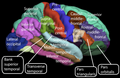 Lateral surface of cerebral cortex - gyri


See Also[edit]

