Karyolysidae: Difference between revisions
CSV import |
No edit summary |
||
| Line 43: | Line 43: | ||
[[Category:Parasitic protists]] | [[Category:Parasitic protists]] | ||
[[Category:Invertebrate parasites]] | [[Category:Invertebrate parasites]] | ||
<gallery> | <gallery> | ||
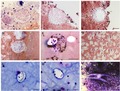
File:Parasite150031-fig1 Systematic revision of the adeleid haemogregarines.tif|Systematic revision of the adeleid haemogregarines | File:Parasite150031-fig1 Systematic revision of the adeleid haemogregarines.tif|Systematic revision of the adeleid haemogregarines | ||
</gallery> | </gallery> | ||
Latest revision as of 00:13, 17 March 2025
Karyolysidae is a family of parasitic protozoa within the phylum Apicomplexa. Members of this family are known to infect the nuclei of their host cells, a characteristic that distinguishes them from other apicomplexan parasites. The family Karyolysidae is not as well-studied as some other families within Apicomplexa, such as the Plasmodiidae (which includes the malaria parasites), but it is of interest due to its unique intracellular lifestyle.
Morphology and Life Cycle[edit]
Karyolysidae are characterized by their ability to invade and reside within the nucleus of host cells. This nuclear parasitism is relatively rare among protozoans, making Karyolysidae an interesting subject for research. The life cycle of Karyolysidae typically involves both asexual and sexual reproduction, with the formation of sporozoites that are capable of infecting new host cells.
The life cycle stages include:
- Trophozoite: The active, feeding stage that resides within the host cell nucleus.
- Schizont: A stage of asexual reproduction where multiple nuclear divisions occur, leading to the formation of merozoites.
- Merozoite: The result of schizogony, these are released to infect new cells.
- Gametocyte: The sexual stage that differentiates into male and female gametes.
- Oocyst: The product of fertilization, which undergoes sporogony to produce sporozoites.
Host Range and Pathogenicity[edit]
Karyolysidae primarily infect invertebrates, with a preference for arthropods such as insects. The pathogenic effects of Karyolysidae infections can vary, but they often result in cellular damage due to the disruption of nuclear functions. In some cases, this can lead to significant morbidity in the host organism.
Research and Importance[edit]
Research on Karyolysidae is ongoing, with a focus on understanding their unique nuclear parasitism and its implications for host cell biology. Studies on Karyolysidae can provide insights into the evolution of parasitism and the mechanisms by which parasites manipulate host cell environments.
Also see[edit]
| Apicomplexa Overview | |
|---|---|
| Kingdom | Protista |
| Phylum | Apicomplexa |
| Characteristics | Obligate intracellular parasites, complex life cycles, apical complex structure |
| Notable Genera | Plasmodium, Toxoplasma, Cryptosporidium, Eimeria |
| Diseases Caused | Malaria, Toxoplasmosis, Cryptosporidiosis, Coccidiosis |
| Reproduction | Sexual and asexual phases, often involving multiple hosts |
| Research Importance | Study of parasitic diseases, vaccine development, drug resistance |
| Related Articles | Protozoa, Parasitology, Infectious disease |
-
 Systematic revision of the adeleid haemogregarines
