Hydroxyflutamide: Difference between revisions
CSV import |
No edit summary |
||
| Line 28: | Line 28: | ||
{{pharma-stub}} | {{pharma-stub}} | ||
{{medicine-stub}} | {{medicine-stub}} | ||
<gallery> | <gallery> | ||
File:Hydroxyflutamide.svg|Hydroxyflutamide | File:Hydroxyflutamide.svg|Hydroxyflutamide | ||
File:Hydroxyflutamide molecule ball.png|Hydroxyflutamide molecule ball | File:Hydroxyflutamide molecule ball.png|Hydroxyflutamide molecule ball | ||
</gallery> | </gallery> | ||
Latest revision as of 00:01, 17 March 2025
Hydroxyflutamide is an active metabolite of the synthetic antiandrogen flutamide. It is primarily used in the treatment of prostate cancer, and works by blocking the effects of androgens, such as testosterone, in the body.
Pharmacology[edit]
Hydroxyflutamide is a nonsteroidal antiandrogen (NSAA) that acts as a selective antagonist of the androgen receptor (AR). It competes with androgens like testosterone and dihydrotestosterone (DHT) for binding to the AR, thereby preventing them from activating the receptor and stimulating the growth of prostate cancer cells.
Clinical use[edit]
Hydroxyflutamide is used in the treatment of prostate cancer, usually in combination with other medications such as luteinizing hormone-releasing hormone (LHRH) agonists. It can also be used to treat hirsutism in women, as well as other conditions that are exacerbated by androgens.
Side effects[edit]
Common side effects of hydroxyflutamide include gynecomastia, hot flashes, and diarrhea. Less common side effects can include liver toxicity, which can be severe in some cases.
History[edit]
Hydroxyflutamide was first synthesized in the 1960s, and has been in clinical use since the 1980s. It is a derivative of flutamide, which was the first NSAA to be introduced for medical use.
See also[edit]


-
 Hydroxyflutamide
 -
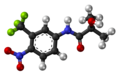 Hydroxyflutamide molecule ball


