Goiabada: Difference between revisions
CSV import |
No edit summary |
||
| Line 22: | Line 22: | ||
[[Category:Desserts]] | [[Category:Desserts]] | ||
{{food-stub}} | {{food-stub}} | ||
<gallery> | <gallery> | ||
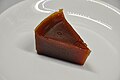
File:Goiabada slice.jpg|Goiabada | File:Goiabada slice.jpg|Goiabada | ||
</gallery> | </gallery> | ||
Latest revision as of 23:33, 16 March 2025
Goiabada is a popular dessert in the Portuguese and Brazilian cultures. It is a sweet made from guavas and sugar, cooked until they achieve a firm, jelly-like consistency. The dessert is often served with cheese, a combination known as Romeo and Juliet in Brazil.
History[edit]
The origins of Goiabada can be traced back to the Portuguese sweet, marmelada, which is made from quinces and sugar. When the Portuguese colonized Brazil, they adapted the recipe to use guavas, which were abundant in the region. The name Goiabada comes from the Portuguese word for guava, goiaba.
Preparation[edit]
The preparation of Goiabada involves boiling guavas and sugar together until the mixture thickens. The mixture is then poured into a mold and left to cool, resulting in a firm, jelly-like dessert. Some recipes also include lemon juice or pectin to help the mixture set.
Consumption[edit]
Goiabada is often consumed on its own or used as a filling for cakes and pastries. In Brazil, it is commonly served with a slice of Minas cheese, a combination known as Romeo and Juliet. This pairing is particularly popular during the Festa Junina, a traditional Brazilian festival.
Variations[edit]
There are several variations of Goiabada, including Goiabada Cascão, which includes pieces of guava peel, and Goiabada Cremosa, a creamier version of the dessert.
See also[edit]

-
 Goiabada

