Aminopropionitrile: Difference between revisions
CSV import |
No edit summary |
||
| Line 25: | Line 25: | ||
{{Chem-stub}} | {{Chem-stub}} | ||
{{medicine-stub}} | {{medicine-stub}} | ||
<gallery> | <gallery> | ||
File:aminopropionitrile.png|Aminopropionitrile structure | File:aminopropionitrile.png|Aminopropionitrile structure | ||
File:Aminopropionitrile 3D ball.png|Aminopropionitrile 3D ball model | File:Aminopropionitrile 3D ball.png|Aminopropionitrile 3D ball model | ||
</gallery> | </gallery> | ||
Latest revision as of 19:02, 16 March 2025
Aminopropionitrile (also known as beta-aminopropionitrile or BAPN) is a chemical compound that is used in biochemistry and medicine for its inhibitory effects on the enzyme lysyl oxidase. This enzyme is responsible for the cross-linking of collagen and elastin, which are essential components of the extracellular matrix in animals.
Chemical Structure and Properties[edit]
Aminopropionitrile is a small, organic molecule with the chemical formula C3H6N2. It contains a nitrile group (-CN) and an amino group (-NH2), which are attached to a three-carbon alkane backbone. The molecule is polar due to the presence of these functional groups, and it is soluble in water.
Biological Effects[edit]
In the body, aminopropionitrile acts as a lysyl oxidase inhibitor, preventing the enzyme from catalyzing the formation of cross-links in collagen and elastin. This can lead to a condition known as lathyrism, which is characterized by weakened connective tissues and can cause symptoms such as joint laxity and skin elasticity.
Medical Uses[edit]
Aminopropionitrile has been used in research to study the role of lysyl oxidase in various diseases, including cancer, fibrosis, and cardiovascular disease. It has also been used to induce experimental lathyrism in animals, which can provide insights into the pathology of connective tissue disorders.
Safety and Toxicity[edit]
Exposure to aminopropionitrile can cause irritation to the eyes, skin, and respiratory tract. Ingestion or inhalation of large amounts can lead to symptoms of lathyrism. Therefore, appropriate safety measures should be taken when handling this compound.
See Also[edit]


-
 Aminopropionitrile structure
 -
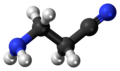 Aminopropionitrile 3D ball model


