Ontogeny: Difference between revisions
CSV import |
No edit summary |
||
| Line 1: | Line 1: | ||
[[File:HumanEmbryogenesis.svg|Human Embryogenesis Diagram|thumb]] | |||
[[File:Human_embryo_8_weeks_2.JPG|Human Embryo at 8 Weeks|left|thumb]] | |||
[[File:Figure_27_01_03.jpg|Developmental Stages|thumb]] | |||
[[File:Blastula.png|Blastula Stage|thumb]] | |||
'''Ontogeny''' refers to the development of an individual organism or anatomical or behavioral feature from the earliest stage to maturity. The term is derived from two Greek words, "ontos" meaning "being" and "geneia" meaning "origin". The concept of ontogeny is central to the field of [[developmental biology]]. | '''Ontogeny''' refers to the development of an individual organism or anatomical or behavioral feature from the earliest stage to maturity. The term is derived from two Greek words, "ontos" meaning "being" and "geneia" meaning "origin". The concept of ontogeny is central to the field of [[developmental biology]]. | ||
| Line 21: | Line 25: | ||
The study of ontogeny can provide valuable insights into the process of evolution. By studying the developmental processes of different organisms, scientists can gain a better understanding of how these organisms have evolved over time. | The study of ontogeny can provide valuable insights into the process of evolution. By studying the developmental processes of different organisms, scientists can gain a better understanding of how these organisms have evolved over time. | ||
== Gallery == | |||
<gallery> | |||
File:Germ_layers.jpg|Germ Layers | |||
File:Ernst_Haeckel,_Anthropogenie._Wellcome_L0027291.jpg|Ernst Haeckel's Anthropogenie | |||
File:2912_Neurulation-02.jpg|Neurulation Process | |||
File:Acraea_zetes_caterpillar_to_pupae_to_butterfly_metamorphosis_by_Nick_Hobgood.jpg|Acraea zetes Metamorphosis | |||
</gallery> | |||
== See Also == | == See Also == | ||
| Line 29: | Line 40: | ||
* [[Phylogeny]] | * [[Phylogeny]] | ||
* [[Biogenetic law]] | * [[Biogenetic law]] | ||
[[Category:Biology]] | [[Category:Biology]] | ||
[[Category:Developmental biology]] | [[Category:Developmental biology]] | ||
[[Category:Evolutionary biology]] | [[Category:Evolutionary biology]] | ||
{{stub}} | {{stub}} | ||
Latest revision as of 21:42, 11 March 2025


Ontogeny refers to the development of an individual organism or anatomical or behavioral feature from the earliest stage to maturity. The term is derived from two Greek words, "ontos" meaning "being" and "geneia" meaning "origin". The concept of ontogeny is central to the field of developmental biology.
History[edit]
The concept of ontogeny has been around since the 19th century, with the term being coined by the German biologist Ernst Haeckel. Haeckel proposed a theory known as the biogenetic law, which states that the development of an individual organism (its ontogeny) recapitulates the evolutionary development of its species (its phylogeny).
Ontogeny and Phylogeny[edit]
Ontogeny and phylogeny are two fundamental aspects of biological development and evolution. While ontogeny deals with the development of an individual organism, phylogeny deals with the evolutionary history of a species or group of related species. The relationship between ontogeny and phylogeny has been a subject of scientific debate and research for many years.
Ontogenetic Development[edit]
Ontogenetic development involves various stages, starting from the fertilization of the egg (zygote) to the maturity of the organism. These stages include embryogenesis, morphogenesis, and organogenesis. Each stage involves complex biological processes and is regulated by various genetic and environmental factors.
Ontogeny in Different Organisms[edit]
The process of ontogeny varies greatly among different organisms. In mammals, for example, ontogeny involves the development of the embryo inside the mother's womb, while in birds and reptiles, it involves the development of the embryo inside an egg. In plants, ontogeny involves the development of the plant from a seed.
Ontogeny and Evolution[edit]
The study of ontogeny can provide valuable insights into the process of evolution. By studying the developmental processes of different organisms, scientists can gain a better understanding of how these organisms have evolved over time.
Gallery[edit]
-
 Germ Layers
 -
 Ernst Haeckel's Anthropogenie
 -
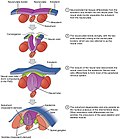 Neurulation Process
 -
 Acraea zetes Metamorphosis


