Root-knot nematode: Difference between revisions
CSV import |
CSV import |
||
| Line 26: | Line 26: | ||
{{Nematode-stub}} | {{Nematode-stub}} | ||
{{food-stub}} | {{food-stub}} | ||
== Root-knot nematode gallery == | |||
<gallery> | |||
File:A juvenile root-knot nematode (Meloidogyne incognita) penetrates a tomato root - USDA-ARS.jpg|A juvenile root-knot nematode (Meloidogyne incognita) penetrates a tomato root | |||
File:Nematode nodules.jpg|Nematode nodules | |||
</gallery> | |||
Latest revision as of 06:20, 3 March 2025
Root-knot nematode is a common name for a type of parasitic nematode (roundworm) that infects the roots of plants. These nematodes are part of the genus Meloidogyne, which includes several species that are significant pests in agriculture and horticulture.
Life Cycle[edit]
The life cycle of the root-knot nematode begins with the egg, which hatches to release a juvenile nematode. This juvenile nematode is mobile and seeks out the roots of plants to infect. Once it has penetrated a root, it establishes a feeding site and begins to grow, causing the formation of characteristic 'knots' or galls on the root. The nematode matures within the gall, eventually producing eggs which are released into the soil to begin the cycle again.
Impact on Agriculture[edit]
Root-knot nematodes are a significant problem in agriculture due to the damage they cause to crops. The galls they form on roots interfere with the plant's ability to absorb water and nutrients, leading to stunted growth, yellowing leaves, and reduced yield. In severe infestations, root-knot nematodes can cause complete crop failure.
Crops that are particularly susceptible to root-knot nematode infestation include tomato, carrot, potato, and eggplant, among others. However, these nematodes have a wide host range and can infect many different types of plants.
Management[edit]
Management of root-knot nematodes in agricultural settings typically involves a combination of cultural practices, biological control agents, and chemical nematicides. Cultural practices may include crop rotation with non-host plants, use of resistant cultivars, and soil solarization. Biological control agents such as nematophagous fungi and predatory nematodes can also be used to reduce nematode populations in the soil. Chemical nematicides are often used as a last resort due to their potential environmental impact.
See Also[edit]
References[edit]
<references />

Root-knot nematode gallery[edit]
-
 A juvenile root-knot nematode (Meloidogyne incognita) penetrates a tomato root
 -
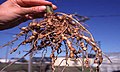 Nematode nodules
_penetrates_a_tomato_root_-_USDA-ARS.jpg)


