Artificial intelligence: Difference between revisions
Created page with "'''Artificial Intelligence''' ('''AI''') refers to the simulation of human intelligence in machines that are programmed to think like humans and mimic their actions. The term..." |
CSV import |
||
| Line 25: | Line 25: | ||
{{Computer Science}} | {{Computer Science}} | ||
{{Technology-stub}} | {{Technology-stub}} | ||
== Artificial intelligence gallery == | |||
<gallery> | |||
File:General Formal Ontology.svg|General Formal Ontology | |||
File:Supervised and unsupervised learning.png|Supervised and unsupervised learning | |||
File:Kismet-IMG 6007-gradient.jpg|Kismet | |||
File:Gradient descent.gif|Gradient descent | |||
File:SimpleBayesNet.svg|Simple Bayes Net | |||
File:EM Clustering of Old Faithful data.gif|EM Clustering of Old Faithful data | |||
File:Artificial neural network.svg|Artificial neural network | |||
File:AI hierarchy.svg|AI hierarchy | |||
File:Vincent van Gogh in watercolour.png|Vincent van Gogh in watercolour | |||
File:Vice President Harris at the group photo of the 2023 AI Safety Summit.jpg|Vice President Harris at the group photo of the 2023 AI Safety Summit | |||
</gallery> | |||
Latest revision as of 06:19, 3 March 2025
Artificial Intelligence (AI) refers to the simulation of human intelligence in machines that are programmed to think like humans and mimic their actions. The term may also be applied to any machine that exhibits traits associated with a human mind such as learning and problem-solving.
Definition[edit]
The proper definition of artificial intelligence is often a subject of debate. However, it is generally accepted that any device that perceives its environment and takes actions to maximize its chance of successfully achieving its goals can be considered as having some form of AI.
History[edit]
The concept of artificial intelligence was first proposed by Alan Turing in the 1950s. He suggested that machines could be made to mimic human intelligence, and this idea has been developed and refined over the decades.
Types of AI[edit]
There are two types of AI: weak AI and strong AI. Weak AI, also known as narrow AI, is an AI system that is designed and trained for a particular task. In contrast, strong AI, also known as artificial general intelligence, is an AI system with generalized human cognitive abilities.
Applications[edit]
AI has been used in a wide range of fields including healthcare, robotics, finance, aviation, and education. It has the potential to perform tasks that are dangerous or tedious for humans, such as data analysis, prediction, and pattern recognition.
Ethics and Controversy[edit]
There are many ethical and societal concerns related to AI, such as job loss due to automation, privacy issues, and the potential misuse of AI technology.
Future of AI[edit]
The future of AI is uncertain and subject to much speculation. Some predict that AI will outperform humans in most economically valuable work within the next fifty years, while others believe that AI will not achieve human-level intelligence in the foreseeable future.
| Artificial Intelligence | ||||||||||
|---|---|---|---|---|---|---|---|---|---|---|
This artificial intelligence related article is a stub.
|
| Computer Science | ||||||||||
|---|---|---|---|---|---|---|---|---|---|---|
This Computer Science related article is a stub.
|

Artificial intelligence gallery[edit]
-
 General Formal Ontology
 -
 Supervised and unsupervised learning
 -
 Kismet
 -
 Gradient descent
 -
 Simple Bayes Net
 -
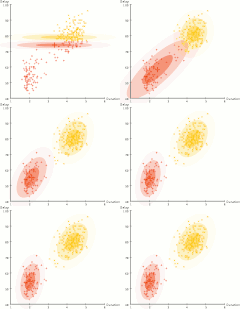 EM Clustering of Old Faithful data
 -
 Artificial neural network
 -
 AI hierarchy
 -
 Vincent van Gogh in watercolour
 -
 Vice President Harris at the group photo of the 2023 AI Safety Summit


