Cycloaddition: Difference between revisions
CSV import Tags: mobile edit mobile web edit |
CSV import |
||
| Line 30: | Line 30: | ||
{{Chemistry-stub}} | {{Chemistry-stub}} | ||
<gallery> | |||
File:14plus2.png|14 plus 2 | |||
File:CinnamicAcidCycloAddition.png|Cinnamic Acid Cycloaddition | |||
File:Bpe-resorcinol-cycloaddition.png|Bpe-resorcinol cycloaddition | |||
File:Qcane.png|Qcane | |||
File:Diels-Alder (1,3-butadiene + ethylene) red.svg|Diels-Alder (1,3-butadiene + ethylene) | |||
File:Thermal Huisgen cycloaddition.png|Thermal Huisgen cycloaddition | |||
File:NitrGen.svg|NitrGen | |||
File:Cheletropic reaction of butadiene with SO2.svg|Cheletropic reaction of butadiene with SO2 | |||
File:3+3 cycloaddition - cyclic iminium to cyclic enone.svg|3+3 cycloaddition - cyclic iminium to cyclic enone | |||
</gallery> | |||
Latest revision as of 06:11, 3 March 2025
Cycloaddition is a type of chemical reaction in which two or more unsaturated molecules (or parts of the same molecule) combine with the formation of a cyclic adduct in which there is a net reduction of the bond multiplicity. Cycloadditions are categorized as pericyclic reactions, which proceed via a concerted mechanism that involves a cyclic redistribution of bonding electrons. The most common types of cycloadditions are the Diels-Alder reaction, which is a [4+2] cycloaddition, and the 1,3-dipolar cycloaddition, often referred to as the Huisgen cycloaddition.
Mechanism[edit]
Cycloaddition reactions proceed through a concerted mechanism that involves the simultaneous making of new bonds without the formation of intermediates. The transition state of a cycloaddition reaction is a cyclic geometry that allows for the optimal overlap of the reacting orbitals. The symmetry of the orbitals involved determines the allowedness of the reaction under the Woodward-Hoffmann rules. For example, the Diels-Alder reaction is allowed under thermal conditions because it involves the suprafacial interaction of the π systems.
Types of Cycloaddition[edit]
Diels-Alder Reaction[edit]
The Diels-Alder reaction is a [4+2] cycloaddition between a diene and a dienophile. It is widely used in the synthesis of complex natural products and polymers. The reaction is stereospecific, producing a defined stereochemistry in the adduct.
1,3-Dipolar Cycloaddition[edit]
The 1,3-dipolar cycloaddition involves the reaction of a 1,3-dipole with a dipolarophile to form a five-membered ring. This reaction is often associated with the synthesis of heterocycles and is utilized in click chemistry, notably in the Huisgen cycloaddition, which is a copper-catalyzed version.
[2+2] Cycloaddition[edit]
The [2+2] cycloaddition involves the reaction of two alkenes to form a cyclobutane. This reaction is symmetry forbidden under thermal conditions but can proceed with photochemical activation, which allows for the reaction to occur via a different orbital symmetry.
Applications[edit]
Cycloaddition reactions are pivotal in the synthesis of complex molecular architectures, including natural products, pharmaceuticals, and polymers. They are particularly valued for their ability to construct cyclic structures with high stereochemical control.
Limitations[edit]
While cycloadditions are versatile and powerful synthetic tools, they are sometimes limited by the need for specific reactive functional groups and the inherent reactivity of the substrates. Additionally, some cycloadditions are symmetry forbidden under thermal conditions and require photochemical activation to proceed.
See Also[edit]

-
 14 plus 2
 -
 Cinnamic Acid Cycloaddition
 -
 Bpe-resorcinol cycloaddition
 -
 Qcane
Qcane -
 Diels-Alder (1,3-butadiene + ethylene)
 -
 Thermal Huisgen cycloaddition
 -
 NitrGen
 -
 Cheletropic reaction of butadiene with SO2
 -
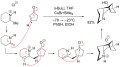 3+3 cycloaddition - cyclic iminium to cyclic enone


_red.svg)


