Freshwater whitefish: Difference between revisions
CSV import |
CSV import |
||
| Line 26: | Line 26: | ||
{{Fish-stub}} | {{Fish-stub}} | ||
{{food-stub}} | {{food-stub}} | ||
<gallery> | |||
File:Coregonushoyi.jpg|Coregonus hoyi | |||
File:Lox-and-smoked-whitefish-01.jpg|Lox and smoked whitefish | |||
</gallery> | |||
Latest revision as of 06:08, 3 March 2025
Freshwater whitefish are fishes of the subfamily Coregoninae, which contains whitefishes (both freshwater and anadromous) and ciscoes, and is one of three subfamilies in the salmon family Salmonidae. Despite the name "whitefish", the species are not all white. The name is believed to come from the white, flaky flesh of the fish, which is a common characteristic of the species.
Species and Distribution[edit]
The subfamily Coregoninae includes about 68 species, including species known as whitefish, cisco, lake herring, tullibee, and inconnu. These species are found in temperate waters of the Northern Hemisphere, with the greatest diversity in the North American Great Lakes region and the Siberian region of Russia.
Characteristics[edit]
Freshwater whitefish are typically medium-sized fishes, ranging from about 20 to 80 cm in length. They have a silvery, streamlined appearance, with a forked tail and a small head. The body is typically covered with small, smooth scales. The coloration varies, but is generally silvery-white, giving these fish their common name.
Diet and Behavior[edit]
Freshwater whitefish are typically omnivorous, feeding on a diet of insects, crustaceans, and small fishes. Some species are more specialized, feeding primarily on plankton, while others are more generalist, feeding on a variety of prey. They are schooling fish, and often form large schools, particularly during spawning season.
Economic Importance[edit]
Many species of freshwater whitefish are important for commercial and recreational fishing. They are prized for their delicate, flaky flesh, which is often smoked or used in various culinary dishes. Some species, such as the Lake whitefish, are also raised in aquaculture for food production.
Conservation[edit]
While many species of freshwater whitefish are still abundant, some are threatened by habitat loss, pollution, and overfishing. Conservation efforts for these species typically involve habitat restoration, pollution control, and regulation of fishing.


-
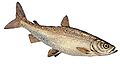 Coregonus hoyi
 -
Lox and smoked whitefish


