Behavioral modernity: Difference between revisions
CSV import |
CSV import |
||
| Line 45: | Line 45: | ||
[[Category:Anthropology]] | [[Category:Anthropology]] | ||
[[Category:Prehistoric archaeology]] | [[Category:Prehistoric archaeology]] | ||
== Behavioral modernity gallery == | |||
<gallery> | |||
File:Lascaux painting.jpg|Lascaux painting | |||
File:Festiwal Polka 1 Fot.Wojtek Korpusik.jpg|Festiwal Polka 1 Fot. Wojtek Korpusik | |||
</gallery> | |||
Latest revision as of 06:00, 3 March 2025
The development of modern human behavior and culture
| Taxonomy (Hominins) |
| ||||||||||||||||||||||||||
|---|---|---|---|---|---|---|---|---|---|---|---|---|---|---|---|---|---|---|---|---|---|---|---|---|---|---|---|
| Ancestors |
| ||||||||||||||||||||||||||
| Models |
| ||||||||||||||||||||||||||
| Timelines | |||||||||||||||||||||||||||
| Others | |||||||||||||||||||||||||||


Behavioral modernity refers to a set of traits that distinguish present-day humans and their recent ancestors from both living primates and extinct hominid species. This concept is often used to describe the point at which Homo sapiens began to demonstrate a range of behaviors and cognitive abilities that are considered "modern" or "advanced" compared to earlier hominins.
Characteristics[edit]
Behavioral modernity is characterized by a number of key features, including:
- Symbolic thought: The ability to use symbols, such as language and art, to represent ideas and concepts.
- Cultural creativity: The production of art, music, and other forms of cultural expression.
- Complex tool use: The creation and use of sophisticated tools and technology.
- Social organization: The development of complex social structures and networks.
- Economic specialization: The division of labor and the development of trade networks.
- Ritual and religion: The practice of rituals and the development of religious beliefs.
Theories of Emergence[edit]
There are several theories regarding the emergence of behavioral modernity:
- The "Great Leap Forward" hypothesis suggests that behavioral modernity arose suddenly around 50,000 years ago, possibly due to a genetic mutation that enhanced cognitive abilities.
- Gradualist models propose that modern behaviors developed gradually over a longer period, starting as early as 200,000 years ago.
- Cultural diffusion theories argue that modern behaviors spread through cultural exchange and interaction between different human groups.
Archaeological Evidence[edit]
Evidence for behavioral modernity is found in the archaeological record, including:
- Cave art: Such as the paintings found in the Lascaux and Chauvet Caves in France.
- Ornamental objects: Beads, pendants, and other decorative items that suggest symbolic thinking.
- Advanced tools: Such as the Aurignacian blade technology.
- Burial practices: Evidence of intentional burial and grave goods, indicating ritual behavior.
Debates and Controversies[edit]
The concept of behavioral modernity is subject to ongoing debate among anthropologists and archaeologists. Some argue that the criteria for modernity are too Eurocentric, while others question the validity of distinguishing between "modern" and "archaic" behaviors.
Also see[edit]
References[edit]
<references group="" responsive="1"></references>
Behavioral modernity gallery[edit]
-
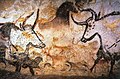 Lascaux painting
 -
 Festiwal Polka 1 Fot. Wojtek Korpusik


