Australopithecus afarensis
Australopithecus afarensis is an extinct hominin species that is considered one of the earliest ancestors of modern humans. The species was first discovered in the 1970s in the Afar Region of Ethiopia, hence the name 'afarensis'.
Discovery[edit]
The first fossils of Australopithecus afarensis were discovered in 1974 by a team of paleoanthropologists led by Donald Johanson. The most famous specimen, known as "Lucy", was found in the Afar Region of Ethiopia and is estimated to be 3.2 million years old. Other significant fossils have been found in Tanzania and Kenya, extending the known range of the species.
Anatomy and Physiology[edit]
Australopithecus afarensis had a combination of traits found in both apes and humans. The species had a small brain, similar in size to modern chimpanzees, but walked upright on two legs, a characteristic associated with humans. The structure of the hands and feet suggests that Australopithecus afarensis was capable of both walking and climbing trees.
Diet[edit]
The diet of Australopithecus afarensis is believed to have been primarily vegetarian, based on the structure of the teeth and jaws. The species had large molars and premolars, which are adapted for grinding plant material, and a powerful jaw muscle for chewing.
Social Behavior[edit]
Little is known about the social behavior of Australopithecus afarensis, but some researchers believe that the species lived in small groups, similar to modern apes. The presence of both male and female fossils at many sites suggests that the species may have had a complex social structure.
Significance[edit]
The discovery of Australopithecus afarensis has had a significant impact on our understanding of human evolution. The species provides evidence for the evolution of bipedalism, a key characteristic that distinguishes humans from other primates.
 | This paleontology article is a stub. You can help WikiMD by expanding the page. |
Australopithecus afarensis gallery[edit]
-
 Reconstruction of the fossil skeleton of "Lucy" the Australopithecus afarensis
 -
 LH 4 Replica
 -
 Afarensis Africa
 -
 BH-021-T-A-afarensis-Lucy-3qtrR-Lo
 -
 Australopithecus afarensis skull - Naturmuseum Senckenberg
 -
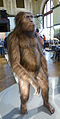 NHM - Australopithecus afarensis Modell 1
 -
 NHM - Australopithecus afarensis Modell 2
 -
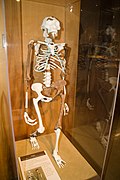 Lucy Skeleton
 -
 Resti di australopithecus afarensis detto selam, di tre anni circa, da dikika (afar), 3,3 milioni di anni fa
 -
 A Visual Comparison of the Pelvis and Bony Birth Canal Vs. the Size of Infant Skull in Primate Species


,_3,3_milioni_di_anni_fa.jpg)

Medical Disclaimer: WikiMD is for informational purposes only and is not a substitute for professional medical advice. Content may be inaccurate or outdated and should not be used for diagnosis or treatment. Always consult your healthcare provider for medical decisions. Verify information with trusted sources such as CDC.gov and NIH.gov. By using this site, you agree that WikiMD is not liable for any outcomes related to its content. See full disclaimer.
Credits:Most images are courtesy of Wikimedia commons, and templates, categories Wikipedia, licensed under CC BY SA or similar.
Translate this page: - East Asian
中文,
日本,
한국어,
South Asian
हिन्दी,
தமிழ்,
తెలుగు,
Urdu,
ಕನ್ನಡ,
Southeast Asian
Indonesian,
Vietnamese,
Thai,
မြန်မာဘာသာ,
বাংলা
European
español,
Deutsch,
français,
Greek,
português do Brasil,
polski,
română,
русский,
Nederlands,
norsk,
svenska,
suomi,
Italian
Middle Eastern & African
عربى,
Turkish,
Persian,
Hebrew,
Afrikaans,
isiZulu,
Kiswahili,
Other
Bulgarian,
Hungarian,
Czech,
Swedish,
മലയാളം,
मराठी,
ਪੰਜਾਬੀ,
ગુજરાતી,
Portuguese,
Ukrainian
