Spider monkey: Difference between revisions
CSV import Tags: mobile edit mobile web edit |
CSV import |
||
| Line 35: | Line 35: | ||
{{Endangered-species-stub}} | {{Endangered-species-stub}} | ||
{{food-stub}} | {{food-stub}} | ||
== Spider monkey gallery == | |||
<gallery> | |||
File:Ateles fusciceps Colombia.JPG|Ateles fusciceps Colombia | |||
File:Spider monkey -Belize Zoo-8b.jpg|Spider monkey - Belize Zoo | |||
File:Spider Monkey Skeleton.jpg|Spider Monkey Skeleton | |||
File:BrownSpiderMonkey (edit2).jpg|Brown Spider Monkey | |||
File:Spider monkey hanging out on a boat in Belize.jpg|Spider monkey hanging out on a boat in Belize | |||
File:Spider Monkey, Tortuguero.jpg|Spider Monkey, Tortuguero | |||
File:Cylinder Vase with spider monkeys, 650-750 AD, Maya culture, central Peten lowlands, Belize or Guatemala, earthenware with brown-black slip - Gardiner Museum, Toronto - DSC01166.JPG|Cylinder Vase with spider monkeys, 650-750 AD, Maya culture | |||
</gallery> | |||
Latest revision as of 05:58, 3 March 2025
Spider Monkey
The Spider Monkey (Ateles) is a genus of New World monkeys that is part of the family Atelidae, like the howler monkey and the woolly monkey. They are native to the tropical forests of Central America, South America, and parts of Mexico.
Characteristics[edit]
Spider monkeys are named for their long, slender limbs and prehensile tails, which they use as a fifth limb in their arboreal locomotion. They are among the largest New World monkeys and can weigh up to 9 kg. Their fur is coarse and varies in color from ruddy gold to brown and black, while their hands and feet are usually black.
Behavior[edit]
Spider monkeys are highly social and live in large groups of up to 35 individuals. These groups are typically matriarchal, with the eldest female leading. They are diurnal and spend most of their day foraging for food. Their diet primarily consists of ripe fruit, but they also consume leaves, flowers, and insects.
Conservation Status[edit]
Several species of spider monkeys are currently listed as endangered or critically endangered on the IUCN Red List. The main threats to their survival are habitat loss due to deforestation and hunting for bushmeat.
Species[edit]
There are seven species of spider monkeys, each with its own range and characteristics. These include the Black-headed Spider Monkey (Ateles fusciceps), the Brown Spider Monkey (Ateles hybridus), and the White-fronted Spider Monkey (Ateles belzebuth).
In Culture[edit]
Spider monkeys have a significant presence in the mythology and folklore of the indigenous cultures of the Americas. They are often depicted as tricksters or as symbols of agility and cunning.
See Also[edit]
.png)
This endangered species related article is a stub. You can help WikiMD by expanding it.

Spider monkey gallery[edit]
-
 Ateles fusciceps Colombia
 -
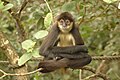 Spider monkey - Belize Zoo
 -
 Spider Monkey Skeleton
 -
 Brown Spider Monkey
 -
 Spider monkey hanging out on a boat in Belize
 -
 Spider Monkey, Tortuguero
 -
 Cylinder Vase with spider monkeys, 650-750 AD, Maya culture


.jpg)


