Mughal Empire: Difference between revisions
CSV import |
CSV import |
||
| Line 36: | Line 36: | ||
{{History of India}} | {{History of India}} | ||
{{food-stub}} | {{food-stub}} | ||
<gallery> | |||
File:Joppen map-India in 1525 published 1907 by Longmans.jpg|Joppen map India in 1525 published 1907 by Longmans | |||
File:Jesuits at Akbar's court.jpg|Jesuits at Akbar's court | |||
File:Khalili Collection Islamic Art mss 0874.3.jpg|Khalili Collection Islamic Art mss 0874.3 | |||
File:Farrukhsiyar Procession in front of the Great Mosque of Delhi.png|Farrukhsiyar Procession in front of the Great Mosque of Delhi | |||
File:Joppen map-India in 1751 published 1907 by Longmans.jpg|Joppen map India in 1751 published 1907 by Longmans | |||
File:Portrait of Bahadur Shah II as calligrapher. Delhi, ca. 1850, Royal Ontario Museum, Toronto. - копия.jpg|Portrait of Bahadur Shah II as calligrapher. Delhi, ca. 1850, Royal Ontario Museum, Toronto | |||
File:Joppen map-India in 1605 published 1907 by Longmans.jpg|Joppen map India in 1605 published 1907 by Longmans | |||
File:Police Chuprasi, Delhi.png|Police Chuprasi, Delhi | |||
File:Coin of Aurangzeb, minted in Kabul.jpg|Coin of Aurangzeb, minted in Kabul | |||
File:Renaldis muslin woman.jpg|Renaldis muslin woman | |||
</gallery> | |||
Latest revision as of 05:50, 3 March 2025
Mughal Empire
The Mughal Empire (also known as Mogul, Timurid, or Hindustan empire) was an early-modern empire in South Asia. For some two centuries, the empire stretched from the outer fringes of the Indus basin in the west, northern Afghanistan in the northwest, and Kashmir in the north, to the highlands of present-day Assam and Bangladesh in the east, and the uplands of the Deccan plateau in south India.
History[edit]
The Mughal Empire was founded by Babur, a Central Asian ruler who was descended from the Turko-Mongol conqueror Timur on his father's side and from Chagatai, the second son of the Mongol ruler Genghis Khan, on his mother's side. Ousted from his ancestral domains in Central Asia, Babur turned to India to satisfy his ambitions. He established himself in Kabul and then pushed steadily southward into India from Afghanistan through the Khyber Pass.
Culture[edit]
The Mughals made a significant contribution to the Indian subcontinent with development of a centralized, imperialistic structure of government, involving the best of Persian, Turkic, and Indian culture. They introduced new trade routes to Arab and Turkic lands. The Mughal Empire did not try to intervene in the local societies during most of its existence, but rather balanced and pacified them through new administrative practices and diverse and inclusive ruling elites, leading to more systematic, centralised, and uniform rule.
Decline[edit]
The empire went into decline in the early 18th century, and by the mid-18th century, it was reduced to the region around Delhi. The empire is considered India's last golden age and one of the three Islamic Gunpowder Empires, along with the Ottoman Empire and Safavid Persia.
See also[edit]
- Babur
- Akbar the Great
- Aurangzeb
- Shah Jahan
- Jahangir
- List of Mughal emperors
- Mughal architecture
- Mughal painting
- Mughal weapons
- Mughal cuisine
| Mughal Empire | ||||||||||
|---|---|---|---|---|---|---|---|---|---|---|
|
| History of India |
|---|
 |
|
|

-
 Joppen map India in 1525 published 1907 by Longmans
 -
 Jesuits at Akbar's court
 -
 Khalili Collection Islamic Art mss 0874.3
 -
 Farrukhsiyar Procession in front of the Great Mosque of Delhi
 -
 Joppen map India in 1751 published 1907 by Longmans
 -
 Portrait of Bahadur Shah II as calligrapher. Delhi, ca. 1850, Royal Ontario Museum, Toronto
 -
 Joppen map India in 1605 published 1907 by Longmans
 -
 Police Chuprasi, Delhi
 -
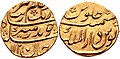 Coin of Aurangzeb, minted in Kabul
 -
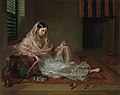 Renaldis muslin woman


