Savoie: Difference between revisions
CSV import |
CSV import |
||
| Line 20: | Line 20: | ||
{{France-geo-stub}} | {{France-geo-stub}} | ||
{{food-stub}} | {{food-stub}} | ||
<gallery> | |||
File:Flag of Savoie Departement.jpg|Flag of Savoie Department | |||
File:Proposition de drapeau fr département Savoie.svg|Proposed Flag of Savoie Department | |||
File:Relief Savoie.GIF|Relief Map of Savoie | |||
File:Paysage de l'avant-pays savoyard.jpg|Landscape of the Avant-Pays Savoyard | |||
File:Plateau du mariet - arith - 1.JPG|Plateau du Mariet, Arith | |||
File:Aime (vue g%C3%A9n%C3%A9rale).JPG|General View of Aime | |||
File:Château des Ducs de Savoie - Chambéry.JPG|Château des Ducs de Savoie, Chambéry | |||
File:Palais de Savoie -Aix-les-Bains.JPG|Palais de Savoie, Aix-les-Bains | |||
File:Hautecombe.jpg|Abbey of Hautecombe | |||
File:Bonneval-sur-Arc vu depuis la route du col de l'Iseran (été 2019).JPG|Bonneval-sur-Arc from the Road to Col de l'Iseran (Summer 2019) | |||
</gallery> | |||
Latest revision as of 05:46, 3 March 2025
Savoie is a department in the Auvergne-Rhône-Alpes region of France. It is named after the historical region of Savoy, which was once a duchy in its own right. Savoie is known for its stunning Alpine landscapes, rich history, and distinctive culinary traditions.
Geography[edit]
Savoie is located in southeastern France, bordering Italy to the east and the French departments of Haute-Savoie, Ain, Isère, and Hautes-Alpes. It is predominantly mountainous, with the western part of the department belonging to the French Prealps, while the eastern part is home to some of the highest peaks in the Alps, including Mont Blanc and the Vanoise massif.
History[edit]
The history of Savoie is intertwined with the history of the House of Savoy, which ruled the region for many centuries. The House of Savoy was established in the 11th century and gradually expanded its territories to include not only Savoie, but also Piedmont in Italy and parts of Switzerland. In 1860, Savoie was annexed by France as part of the Treaty of Turin.
Culture[edit]
Savoie is renowned for its cultural heritage, which includes numerous medieval castles, Baroque churches, and traditional Alpine villages. The local culture is strongly influenced by the region's historical ties with Italy and Switzerland, which is reflected in the local dialect, Franco-Provençal, and the traditional music and dances of Savoie.
Cuisine[edit]
The cuisine of Savoie is hearty and rustic, reflecting the region's alpine environment and agricultural traditions. It is particularly known for its cheeses, such as Beaufort, Reblochon, and Tomme de Savoie, which are used in many local dishes. Other specialties include Tartiflette, a gratin made with potatoes, Reblochon cheese, and bacon, and Raclette, a dish of melted cheese served with potatoes and charcuterie.
Economy[edit]
The economy of Savoie is diverse, with important sectors including agriculture, tourism, and manufacturing. The region is a major producer of cheese, wine, and honey, and its stunning landscapes attract millions of tourists each year, particularly for winter sports such as skiing and snowboarding.

-
 Flag of Savoie Department
 -
 Proposed Flag of Savoie Department
 -
 Relief Map of Savoie
 -
 Landscape of the Avant-Pays Savoyard
 -
 Plateau du Mariet, Arith
 -
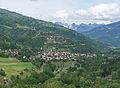 General View of Aime
 -
 Château des Ducs de Savoie, Chambéry
 -
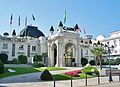 Palais de Savoie, Aix-les-Bains
 -
 Abbey of Hautecombe
 -
 Bonneval-sur-Arc from the Road to Col de l'Iseran (Summer 2019)


.JPG)


.JPG)

