Clement of Alexandria: Difference between revisions
CSV import |
CSV import |
||
| Line 54: | Line 54: | ||
[[Category:150s births]] | [[Category:150s births]] | ||
[[Category:210s deaths]] | [[Category:210s deaths]] | ||
<gallery> | |||
File:Clement alexandrin.jpg|Clement Alexandrin | |||
File:Klementos Alexandreos ta heuriskomena.tif|Klementos Alexandreos ta heuriskomena | |||
File:DSC00355 - Orfeo (epoca romana) - Foto G. Dall'Orto.jpg|Orfeo (epoca romana) | |||
File:Jesus-Christ-from-Hagia-Sophia.jpg|Jesus Christ from Hagia Sophia | |||
File:Alpine flora logan pass.jpg|Alpine flora Logan Pass | |||
File:Carton de vitrail de la chapelle Saint Ferdinand Saint Clément d'Alexandrie.jpg|Carton de vitrail de la chapelle Saint Ferdinand Saint Clément d'Alexandrie | |||
</gallery> | |||
Latest revision as of 05:36, 3 March 2025
Clement of Alexandria (c. 150 – c. 215 AD) was an early Christian theologian and philosopher who taught at the Catechetical School of Alexandria. He was one of the most prominent figures in early Christianity and played a significant role in the development of Christian thought.
Early Life and Education[edit]
Clement was born in Athens, Greece, around 150 AD. He was educated in the classical Greek tradition and was well-versed in philosophy, literature, and rhetoric. His education laid the foundation for his later work in integrating Christian theology with Greek philosophy.
Career[edit]
Clement moved to Alexandria, where he became a student of Pantaenus, the head of the Catechetical School. After Pantaenus's death, Clement succeeded him as the head of the school. Under his leadership, the school became a center for Christian learning and attracted students from across the Roman Empire.
Works[edit]
Clement's most notable works include:
- Protrepticus (Exhortation to the Greeks) - A work aimed at converting pagans to Christianity by demonstrating the superiority of Christian teachings over pagan beliefs.
- Paedagogus (The Instructor) - A treatise on Christian ethics and moral instruction, emphasizing the role of Christ as the divine teacher.
- Stromata (Miscellanies) - A collection of writings on various topics, blending philosophy, theology, and ethics.
Influence and Legacy[edit]
Clement's work was instrumental in the development of Christian apologetics and the integration of Greek philosophy into Christian doctrine. His writings influenced later theologians such as Origen and Athanasius of Alexandria.
Clement's approach to theology was characterized by his belief in the compatibility of faith and reason. He argued that philosophy was a "preparatory discipline" for understanding Christian truth.
Death[edit]
Clement is believed to have died around 215 AD in Jerusalem, although the exact circumstances of his death are not well-documented.
See Also[edit]
References[edit]
- Henry,
 The Early Church,

 Penguin Books,
 1967,
- Justo L.,
 The Story of Christianity,

 HarperCollins,
 1984,
External Links[edit]
- Catholic Encyclopedia: Clement of Alexandria
- Stanford Encyclopedia of Philosophy: Clement of Alexandria
-
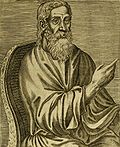 Clement Alexandrin
 -
 Klementos Alexandreos ta heuriskomena
 -
 Orfeo (epoca romana)
 -
 Jesus Christ from Hagia Sophia
 -
 Alpine flora Logan Pass
 -
 Carton de vitrail de la chapelle Saint Ferdinand Saint Clément d'Alexandrie

_-_Foto_G._Dall%27Orto.jpg)


