Lepteutypa cupressi: Difference between revisions
CSV import |
CSV import |
||
| Line 23: | Line 23: | ||
{{Fungi-stub}} | {{Fungi-stub}} | ||
{{No image}} | {{No image}} | ||
<gallery> | |||
File:2015-12-09 Lepteutypa cupressi (Nattrass, C. Booth & B. Sutton) H.J. Swart, (1973) 590458.jpg|Lepteutypa cupressi | |||
</gallery> | |||
Revision as of 05:33, 3 March 2025
Lepteutypa cupressi is a fungal pathogen that primarily affects cypress trees. It is known for causing a disease known as cypress canker, which can lead to significant damage and mortality in affected trees.
Overview
Lepteutypa cupressi is a member of the Ascomycota phylum, which is characterized by the production of spores in a sac-like structure known as an ascus. The fungus is a necrotroph, meaning it derives nutrients from dead or dying tissue. It infects trees through wounds or natural openings, and once established, it kills the surrounding tissue, leading to the formation of cankers.
Symptoms and Impact
The primary symptom of infection by Lepteutypa cupressi is the formation of cankers on the branches and trunk of the tree. These cankers are sunken, discolored areas of dead tissue. As the disease progresses, foliage may turn brown and die, and branches or even the entire tree may die if the cankers girdle the trunk or branch.
Cypress canker can have significant impacts on cypress populations. In addition to causing mortality, it can also reduce the aesthetic value of affected trees, making it a concern in both forestry and landscaping contexts.
Management
Management of cypress canker caused by Lepteutypa cupressi primarily involves preventative measures. This includes avoiding injury to trees, as wounds can provide entry points for the fungus. Regular monitoring for symptoms can also allow for early detection and removal of infected branches or trees.
See Also

-
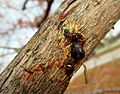 Lepteutypa cupressi
_H.J._Swart,_(1973)_590458.jpg)
