Metsulfuron-methyl: Difference between revisions
CSV import |
CSV import |
||
| Line 24: | Line 24: | ||
{{medicine-stub}} | {{medicine-stub}} | ||
{{No image}} | {{No image}} | ||
<gallery> | |||
File:Metsulfuron methyl.png|Metsulfuron methyl | |||
File:Metsulfuron-methyl-3D-balls.png|Metsulfuron-methyl 3D balls | |||
</gallery> | |||
Revision as of 05:15, 3 March 2025
Metsulfuron-methyl is a sulfonylurea compound that acts as a selective, systemic herbicide. It is absorbed through the roots and foliage of plants, inhibiting the production of essential amino acids needed for plant growth. This chemical is used to control broadleaf weeds and some annual grasses.
Chemical Properties
Metsulfuron-methyl is an odorless, white crystalline solid. It is soluble in water and most organic solvents. The chemical formula for metsulfuron-methyl is C14H15N5O6S.
Mode of Action
Metsulfuron-methyl inhibits the enzyme acetolactate synthase (ALS). This enzyme is crucial for the production of the amino acids leucine, isoleucine, and valine. By inhibiting this enzyme, metsulfuron-methyl prevents the plant from synthesizing these essential amino acids, leading to plant death.
Uses
Metsulfuron-methyl is used in a variety of settings, including agriculture, forestry, and turf management. It is effective against a wide range of broadleaf weeds, including dandelion, clover, and thistle. It is also used to control certain types of annual grasses.
Safety and Environmental Impact
Metsulfuron-methyl is classified as a low toxicity herbicide. However, it can be harmful if swallowed or inhaled, and it can cause eye irritation. It is highly toxic to aquatic organisms and can have long-lasting effects in the environment.
Resistance
Resistance to metsulfuron-methyl and other ALS inhibitors has been reported in several weed species. This resistance is typically due to a mutation in the ALS gene that makes the enzyme insensitive to the herbicide.


-
 Metsulfuron methyl
 -
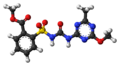 Metsulfuron-methyl 3D balls


