Separase: Difference between revisions
CSV import Tags: mobile edit mobile web edit |
CSV import Tags: mobile edit mobile web edit |
||
| Line 23: | Line 23: | ||
{{enzyme-stub}} | {{enzyme-stub}} | ||
{{medicine-stub}} | {{medicine-stub}} | ||
== Separase gallery == | |||
<gallery> | |||
File:cohesin picture2.png|Cohesin Picture | |||
File:Network picture.png|Network Picture | |||
File:Complete network.jpg|Complete Network | |||
</gallery> | |||
Latest revision as of 05:02, 3 March 2025
Separase is an enzyme that plays a crucial role in the process of cell division. It is also known as ESPL1, which stands for Extra Spindle Pole Bodies Like 1, Separase. This enzyme is a member of the caspase family and is involved in the separation of sister chromatids during mitosis and meiosis.
Function[edit]
Separase is responsible for the cleavage of cohesin, a protein complex that holds sister chromatids together. This cleavage allows the chromatids to separate, enabling cell division to occur. Without the action of separase, cells would not be able to divide properly, leading to problems such as aneuploidy, a condition where a cell has an abnormal number of chromosomes.
Regulation[edit]
The activity of separase is tightly regulated to ensure that it acts at the correct time during cell division. This regulation is achieved through a combination of phosphorylation, inhibition by securin, and proteolysis. Disruptions in these regulatory processes can lead to cell cycle defects and potentially to cancer.
Clinical significance[edit]
Alterations in the function of separase have been implicated in a number of diseases, most notably cancer. Overexpression of separase has been observed in several types of cancer, including breast cancer, ovarian cancer, and lung cancer. This overexpression can lead to aneuploidy and genomic instability, which are hallmarks of cancer cells.
Research[edit]
Research into separase is ongoing, with scientists seeking to better understand its role in cell division and its potential as a target for cancer therapies. Some studies have suggested that inhibiting separase could be a promising strategy for treating certain types of cancer.
This article is a enzyme-related stub. You can help WikiMD by expanding it!

Separase gallery[edit]
-
 Cohesin Picture
 -
 Network Picture
 -
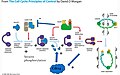 Complete Network


