Bantu peoples: Difference between revisions
CSV import |
CSV import |
||
| Line 32: | Line 32: | ||
{{Ethnic groups in Africa}} | {{Ethnic groups in Africa}} | ||
{{food-stub}} | {{food-stub}} | ||
== Bantu peoples gallery == | |||
<gallery> | |||
File:Bantu zones.png|Bantu zones | |||
File:Niger-Congo speakers.png|Niger-Congo speakers | |||
File:Map of the Bantu languages.svg|Map of the Bantu languages | |||
File:Reconstructing the dispersal of Bantu-speaking populations.jpg|Reconstructing the dispersal of Bantu-speaking populations | |||
File:Bantu Phillipson.png|Bantu Phillipson | |||
File:Mercator Congo map.jpg|Mercator Congo map | |||
File:Zulu Culture.jpg|Zulu Culture | |||
File:Zulu clan.jpg|Zulu clan | |||
File:Zulu Dance-S. Africa.jpg|Zulu Dance-S. Africa | |||
File:Bantu Apartheid publication 1959 01.jpg|Bantu Apartheid publication 1959 | |||
</gallery> | |||
Latest revision as of 04:58, 3 March 2025
Bantu peoples are a large, complex group of ethnolinguistic groups in Africa who speak Bantu languages. They inhabit a geographical area stretching east and southward from Central Africa across the African Great Lakes region down to Southern Africa.
Etymology[edit]
The term "Bantu" means "people" in many Bantu languages. It was first used by Wilhelm Bleek, a German linguist and anthropologist, in the mid-19th century, to denote the languages spoken by these African groups.
History[edit]
The Bantu peoples originated from the Cameroon and Nigeria region of West Africa and began a series of migrations eastward and southward about 4,000 years ago. This Bantu expansion is believed to have played a significant role in shaping the cultural and genetic landscape of Africa.
Culture[edit]
Bantu cultures are diverse, but they share common linguistic roots and similar social structures. Many Bantu societies are matrilineal or patrilineal, and most practice some form of ancestor worship. Bantu communities traditionally live in villages or clusters of villages, with economies based on agriculture, hunting, fishing, and gathering.
Languages[edit]
Bantu languages form a branch of the larger Niger-Congo language family, the largest language family in Africa. There are over 500 Bantu languages spoken by more than 200 million people, including Swahili, Zulu, and Xhosa.
Religion[edit]
Traditional Bantu religions are diverse but often involve belief in a supreme being, spirits, and ancestors, with rituals and ceremonies performed by religious specialists. Many Bantu peoples have also adopted Christianity or Islam.
Notable Bantu peoples[edit]
Notable Bantu groups include the Zulus, Xhosas, and Shonas in Southern Africa; the Kikuyus, Luhyas, and Kambas in East Africa; and the Kongos, Lubas, and Mongos in Central Africa.
See also[edit]
| Ethnic Groups in Africa | ||||||||||
|---|---|---|---|---|---|---|---|---|---|---|
This ethnic groups in Africa related article is a stub.
|

Bantu peoples gallery[edit]
-
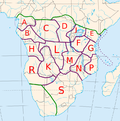 Bantu zones
 -
 Niger-Congo speakers
 -
 Map of the Bantu languages
 -
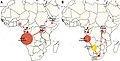 Reconstructing the dispersal of Bantu-speaking populations
 -
Bantu Phillipson
-
Mercator Congo map
-
Zulu Culture
-
Zulu clan
-
Zulu Dance-S. Africa
-
Bantu Apartheid publication 1959


