Sabinene: Difference between revisions
CSV import Tags: mobile edit mobile web edit |
CSV import |
||
| Line 26: | Line 26: | ||
[[Category:Perfume ingredients]] | [[Category:Perfume ingredients]] | ||
[[Category:Essential oils]] | [[Category:Essential oils]] | ||
<gallery> | |||
File:(±)-Sabinene Structural Formulea V.1.svg|(±)-Sabinene Structural Formula V.1 | |||
File:Sabinene BIosynthesis.jpg|Sabinene Biosynthesis | |||
</gallery> | |||
Latest revision as of 04:55, 3 March 2025
Sabinene is a natural monoterpene that is used in the perfume industry due to its pleasant smell. It is named after the conifer genus Sabinene, from which it was first isolated. Sabinene is found in a variety of plants including Norway spruce, Holm oak, and Myristica fragrans (nutmeg). It is also found in the essential oils of many other plants.
Chemistry[edit]
Sabinene is a hydrocarbon with the molecular formula C10H16. It is a member of the terpene family, which are a large and diverse class of organic compounds produced by a variety of plants. Sabinene is a monoterpene, which means it consists of two isoprene units. It is a cyclic compound with a ten-membered ring, which is relatively rare in nature.
Biosynthesis[edit]
The biosynthesis of sabinene involves the mevalonate pathway, which is the metabolic pathway that produces isoprene, the building block of terpenes. The key enzyme in this pathway is geranyl pyrophosphate synthase, which catalyzes the condensation of isopentenyl pyrophosphate and dimethylallyl pyrophosphate to form geranyl pyrophosphate, the precursor of sabinene.
Uses[edit]
Sabinene is used in the perfume industry due to its pleasant smell. It is also used in aromatherapy for its calming and soothing properties. In addition, sabinene has been studied for its potential antioxidant and anti-inflammatory properties.
Safety[edit]
As with all essential oils, sabinene should be used with caution. It can cause skin irritation and should not be used undiluted. Ingestion of sabinene can cause nausea and vomiting.
See also[edit]
References[edit]
<references />

-
 (±)-Sabinene Structural Formula V.1
 -
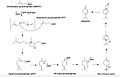 Sabinene Biosynthesis
-Sabinene_Structural_Formulea_V.1.svg)

