Bioremediation of radioactive waste: Difference between revisions
CSV import |
CSV import |
||
| Line 21: | Line 21: | ||
{{Environment-stub}} | {{Environment-stub}} | ||
{{Science-stub}} | {{Science-stub}} | ||
== Bioremediation of radioactive waste == | |||
<gallery> | |||
File:PSM_V74_D230_Three_plants_irradiated_with_a_fourth_as_the_control.png|Three plants irradiated with a fourth as the control | |||
File:Enzymatic_reduction_of_radionuclides_(en).png|Enzymatic reduction of radionuclides | |||
File:Biosorption,_biomineralization_and_bioaccumulation_of_radionuclides_(en).png|Biosorption, biomineralization and bioaccumulation of radionuclides | |||
File:Chernikovite_1.jpg|Chernikovite | |||
File:Evolution_of_the_Old_Rifle_Processing_Site.jpeg|Evolution of the Old Rifle Processing Site | |||
File:Deinococcus_radiodurans.jpg|Deinococcus radiodurans | |||
File:Phytoremediation_Process.svg|Phytoremediation Process | |||
File:Reedbeds_-_geograph.org.uk_-_380204.jpg|Reedbeds | |||
</gallery> | |||
Latest revision as of 00:59, 27 February 2025
Bioremediation of Radioactive Waste is a process that uses biological organisms, primarily microbes, to transform or neutralize radioactive waste. This process is a subset of bioremediation, a broader field that uses biological organisms to clean up various types of environmental pollutants.
Overview[edit]
Radioactive waste is a byproduct of various industrial processes such as nuclear power generation, nuclear medicine, and nuclear weapons production. It poses significant environmental and health risks due to its long-lasting radioactivity. Traditional methods of managing radioactive waste include containment, isolation, and long-term storage. However, these methods are often costly, technically challenging, and pose their own environmental risks.
Bioremediation of radioactive waste offers a potential alternative to these traditional methods. It involves the use of organisms, primarily microbes, that can interact with radioactive materials in ways that render them less harmful. These interactions can include processes such as biosorption, bioaccumulation, and biotransformation.
Mechanisms[edit]
The mechanisms of bioremediation of radioactive waste involve complex biochemical processes. Some microbes can absorb radioactive materials onto their cell surfaces, a process known as biosorption. Others can accumulate radioactive materials within their cells, a process known as bioaccumulation. Still others can transform radioactive materials into less harmful forms, a process known as biotransformation.
Applications[edit]
Bioremediation of radioactive waste has been applied in various settings, including contaminated soil and water. It has also been explored for use in the cleanup of nuclear accidents, such as the Chernobyl disaster and the Fukushima Daiichi nuclear disaster.
Challenges and Future Directions[edit]
Despite its potential, bioremediation of radioactive waste faces several challenges. These include the need for a better understanding of the underlying microbial processes, the development of effective delivery systems for the microbes, and the management of potential risks associated with the use of genetically modified organisms. Future research in this field is likely to focus on addressing these challenges and exploring new applications for this promising technology.

This article is a environment-related stub. You can help WikiMD by expanding it!

Bioremediation of radioactive waste[edit]
-
 Three plants irradiated with a fourth as the control
 -
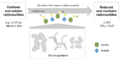 Enzymatic reduction of radionuclides
 -
 Biosorption, biomineralization and bioaccumulation of radionuclides
 -
 Chernikovite
 -
 Evolution of the Old Rifle Processing Site
 -
 Deinococcus radiodurans
 -
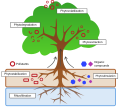 Phytoremediation Process
 -
 Reedbeds

.png)
.png)


