Aposematism: Difference between revisions
CSV import |
CSV import |
||
| Line 44: | Line 44: | ||
[[Category:Evolutionary biology]] | [[Category:Evolutionary biology]] | ||
[[Category:Animal coloration]] | [[Category:Animal coloration]] | ||
<gallery> | |||
File:Korreldragende-gifkikker-3.jpg|Poison dart frog | |||
File:honey_badger.jpg|Honey badger | |||
File:Metasepia_pfefferi_1.jpg|Flamboyant cuttlefish | |||
File:Hycleus_lugens,_Meloidae.jpg|Blister beetle | |||
File:Skunk_about_to_spray.jpg|Skunk about to spray | |||
File:Phyllidia.jpg|Phyllidia sea slug | |||
File:Crown_of_Thorns-jonhanson.jpg|Crown of thorns starfish | |||
File:Variable_ring_patterns_on_mantles_of_the_blue-ringed_octopus_Hapalochlaena_lunulata.png|Blue-ringed octopus | |||
</gallery> | |||
Latest revision as of 00:57, 27 February 2025
Aposematism
Aposematism is a biological phenomenon where organisms develop conspicuous signals, such as bright colors, patterns, or sounds, to warn potential predators of their unpalatability or toxicity. This evolutionary strategy is a form of anti-predator adaptation that benefits both the prey and the predator by reducing the likelihood of a harmful encounter.
Overview[edit]
Aposematism is derived from the Greek words "apo" meaning "away" and "sema" meaning "sign". It is a form of warning coloration that is often associated with other defensive mechanisms such as toxicity, venom, or foul taste. The conspicuous signals serve as a deterrent to predators, who learn to associate these signals with negative experiences.
Mechanisms[edit]
Aposematic signals can take various forms, including:
- Visual Signals: Bright colors and bold patterns are the most common forms of aposematic signals. Examples include the bright red and black coloration of ladybugs and the striking yellow and black stripes of wasps.
- Auditory Signals: Some species use sounds as warning signals. For instance, the rattling of a rattlesnake's tail serves as an auditory warning to potential threats.
- Chemical Signals: Many aposematic species produce chemicals that are toxic or distasteful. These chemicals can be released when the organism is threatened, as seen in skunks and certain species of frogs.
Evolutionary Significance[edit]
Aposematism is an example of coevolution between predators and prey. Predators that learn to avoid aposematic species gain a survival advantage, while prey species that effectively communicate their unpalatability are less likely to be attacked. This mutual benefit can lead to the stabilization of aposematic traits within a population.
Mimicry[edit]
Aposematism is closely related to the concept of mimicry, where non-toxic species evolve to resemble aposematic species. This can occur in two main forms:
- Batesian Mimicry: A harmless species mimics the warning signals of a harmful species to deter predators. An example is the viceroy butterfly, which mimics the appearance of the toxic monarch butterfly.
- Müllerian Mimicry: Two or more harmful species evolve similar warning signals, reinforcing the avoidance behavior in predators. This is seen in various species of poison dart frogs.
Examples in Nature[edit]
Aposematism is widespread across the animal kingdom. Some notable examples include:
- Insects: Many insects, such as bees, wasps, and caterpillars, exhibit aposematic coloration to signal their ability to sting or their unpalatability.
- Amphibians: The poison dart frogs of Central and South America are well-known for their bright colors and toxic skin secretions.
- Reptiles: The coral snake uses its vivid red, yellow, and black bands to warn predators of its venomous bite.
- Mammals: The skunk is a classic example of a mammal with aposematic coloration, using its black and white pattern to warn of its ability to spray a foul-smelling liquid.
Conclusion[edit]
Aposematism is a fascinating example of how organisms evolve complex strategies to survive in their environments. By effectively communicating their defenses, aposematic species reduce the risk of predation and contribute to the dynamic interactions within ecosystems.
| Animal behavior | ||||||||
|---|---|---|---|---|---|---|---|---|
This animal behavior related article is a stub.
|
-
 Poison dart frog
 -
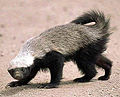 Honey badger
 -
 Flamboyant cuttlefish
 -
 Blister beetle
 -
 Skunk about to spray
 -
 Phyllidia sea slug
 -
 Crown of thorns starfish
 -
 Blue-ringed octopus


