Tết: Difference between revisions
CSV import Tags: mobile edit mobile web edit |
CSV import |
||
| Line 22: | Line 22: | ||
{{Vietnam-stub}} | {{Vietnam-stub}} | ||
{{Asia-holiday-stub}} | {{Asia-holiday-stub}} | ||
<gallery> | |||
File:Xuan_2016_Binh_Than,_duong_nguyen_hue,_phuong_ben_nghe,_Quận_1,_TPHCM,_Việt_Nam_-_panoramio.jpg|Xuan 2016 Binh Than, duong nguyen hue, phuong ben nghe, Quan 1, TPHCM, Viet Nam | |||
File:Cung_tat_nien.jpg|Cung tat nien | |||
File:Phòng_thờ_cúng.jpg|Phòng thờ cúng | |||
File:Ancestors_Altar_or_Gods_Altar_in_Tet,_North_Vietnam.jpg|Ancestors Altar or Gods Altar in Tet, North Vietnam | |||
File:LiXi.jpg|LiXi | |||
File:ĐHNH_2012_-_Rồng_Nhâm_Thìn.JPG|ĐHNH 2012 - Rồng Nhâm Thìn | |||
File:Đèn_kéo_quân.jpg|Đèn kéo quân | |||
File:Ho_Chi_Minh_City_Tet_Decorations.jpg|Ho Chi Minh City Tet Decorations | |||
</gallery> | |||
Latest revision as of 00:53, 27 February 2025
Tết, or Vietnamese New Year, is the most important celebration in Vietnamese culture. The word is a shortened form of Tết Nguyên Đán, which is Sino-Vietnamese for "Feast of the First Morning of the First Day". Tết celebrates the arrival of spring based on the Vietnamese Lunar Calendar, which usually has the date falling in January or February.
History[edit]
The history of Tết in Vietnam can be traced back to ancient times in its traditional agricultural society. Tết was when the Vietnamese commemorated the start of spring after a winter of hard work, and to welcome a new year of better harvests. The holiday also has strong connections to several Vietnamese myths, especially the story of Hùng Kings, who are the traditional founders of Vietnam and are worshipped in Vietnamese society as the symbol of national identity.
Customs[edit]
Tết is a time for families to clean their houses, cook special holiday foods, and offer prayers to the ancestors as well as the gods of the land. Some of the most common foods prepared during Tết are Bánh chưng and Bánh dày, which are traditional Vietnamese rice cakes, and Giò lụa, a Vietnamese pork roll.
Another important custom of Tết is the giving of Lì xì, or lucky money, to children and the elderly. This is usually given in red envelopes, symbolizing luck and good fortune.
Celebrations[edit]
Celebrations of Tết involve the entire community and can last for several days. These include traditional Vietnamese games, the most famous of which is Bầu cua cá cọp, a popular gambling game played during Tết.
See also[edit]

-
 Xuan 2016 Binh Than, duong nguyen hue, phuong ben nghe, Quan 1, TPHCM, Viet Nam
 -
 Cung tat nien
 -
 Phòng thờ cúng
 -
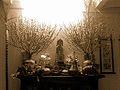 Ancestors Altar or Gods Altar in Tet, North Vietnam
 -
 LiXi
LiXi -
 ĐHNH 2012 - Rồng Nhâm Thìn
 -
 Đèn kéo quân
 -
 Ho Chi Minh City Tet Decorations


