Α-Neurotoxin: Difference between revisions
CSV import |
CSV import |
||
| Line 22: | Line 22: | ||
{{neuroscience-stub}} | {{neuroscience-stub}} | ||
{{toxins-stub}} | {{toxins-stub}} | ||
== Α-Neurotoxin == | |||
<gallery> | |||
File:Alpha-Bungarotoxin_1IDI.png|Alpha-Bungarotoxin 1IDI | |||
</gallery> | |||
Latest revision as of 00:29, 27 February 2025
Α-Neurotoxin is a type of neurotoxin that specifically targets the neuronal nicotinic acetylcholine receptor (nAChR), a type of ionotropic receptor. These toxins are primarily produced by venomous animals such as snakes, spiders, and scorpions.
Structure and Function[edit]
Α-Neurotoxins are typically small proteins composed of 60-70 amino acids. They function by binding to nAChRs, blocking the action of acetylcholine (ACh), a neurotransmitter that is crucial for nerve signal transmission. This blockage inhibits the flow of sodium ions into the neuron, preventing the initiation of an action potential and leading to paralysis.
Types of Α-Neurotoxins[edit]
There are two main types of Α-Neurotoxins: short-chain and long-chain. Short-chain Α-Neurotoxins, such as those found in cobra venom, have a relatively low molecular weight and primarily affect the muscle type nAChRs. Long-chain Α-Neurotoxins, such as those found in krait venom, have a higher molecular weight and affect both muscle and neuronal type nAChRs.
Clinical Significance[edit]
Α-Neurotoxins are of significant clinical interest due to their potential use in the development of drugs for the treatment of neurological disorders, such as Alzheimer's disease and Parkinson's disease. However, their high toxicity and potential for misuse in biological warfare also make them a subject of concern in the field of bioterrorism.
See Also[edit]

This article is a neuroscience stub. You can help WikiMD by expanding it!
Α-Neurotoxin[edit]
-
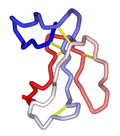 Alpha-Bungarotoxin 1IDI

