Unipolar brush cell: Difference between revisions
No edit summary |
CSV import |
||
| Line 21: | Line 21: | ||
[[Category:Neuroscience]] | [[Category:Neuroscience]] | ||
{{medicine-stub}} | {{medicine-stub}} | ||
<gallery> | |||
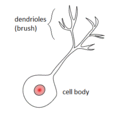
File:Unipolar_brush_cell.GIF|Unipolar brush cell | |||
</gallery> | |||
Latest revision as of 00:26, 27 February 2025
The Unipolar Brush Cell (UBC) is a type of interneuron found primarily in the granule cell layer of the cerebellum. These cells are unique in their morphology and synaptic connections, and play a crucial role in the processing of sensory information.
Morphology[edit]
UBCs are characterized by a single, brush-like dendrite from which they derive their name. This dendrite is covered in numerous small protrusions, or dendritic spines, which form synapses with incoming mossy fiber axons. The cell body of a UBC is small and round, and gives rise to a single, thin axon that projects to the molecular layer of the cerebellum.
Function[edit]
UBCs are thought to play a role in the processing of sensory information in the cerebellum. They receive input from mossy fibers, which carry sensory information from various parts of the body. The unique morphology of UBCs allows them to integrate this information and pass it on to other cells in the cerebellum.
Clinical Significance[edit]
Alterations in the number or function of UBCs have been implicated in a number of neurological disorders, including ataxia, autism, and schizophrenia. Further research is needed to fully understand the role of these cells in health and disease.
See Also[edit]

-
 Unipolar brush cell

