Mitotic catastrophe: Difference between revisions
CSV import |
CSV import |
||
| Line 18: | Line 18: | ||
[[Category:Cancer treatment]] | [[Category:Cancer treatment]] | ||
{{cancer-stub}} | {{cancer-stub}} | ||
<gallery caption="Mitotic_catastrophe"> | |||
File:RPE_cell_that_has_been_treated_with_taxol_and_undergone_mitotic_catastrophe.png|RPE cell that has been treated with taxol and undergone mitotic catastrophe | |||
File:Mitotic_Catastrophe_Diagram_version_2.png|Mitotic Catastrophe Diagram version 2 | |||
File:Spindle_chromosomes-en.png|Spindle chromosomes | |||
File:Cyclin_Expression.svg|Cyclin Expression | |||
File:Normal_and_multipolar_mitosis.tif|Normal and multipolar mitosis | |||
File:Taxol.svg|Taxol | |||
</gallery> | |||
Latest revision as of 21:06, 25 February 2025
Mitotic catastrophe is a mechanism of cell death that is related to mitosis, or the process of cell division. It is considered a fail-safe mechanism used by cells to prevent the propagation of those with severe DNA damage or incorrect chromosome segregation. Mitotic catastrophe is often a precursor to apoptosis (programmed cell death) or necrosis (uncontrolled cell death), and plays a crucial role in preventing cancer development by eliminating cells that have the potential to form tumors.
Mechanism[edit]
Mitotic catastrophe occurs when cells enter mitosis with damaged DNA or errors in chromosome segregation. This can be triggered by various factors, including exposure to radiation, chemotherapy drugs, or other agents that cause DNA damage. The cell's inability to properly align or segregate its chromosomes during mitosis leads to the activation of the mitotic checkpoint, a safety mechanism that halts cell division to allow for DNA repair or to trigger cell death pathways.
If the damage is irreparable, mitotic catastrophe leads to cell death, either through apoptosis or necrosis. This process is characterized by specific morphological changes, including micronucleation (formation of small nuclei), nuclear fragmentation, and the appearance of multi-nucleated giant cells.
Role in Cancer Therapy[edit]
Mitotic catastrophe plays a significant role in cancer therapy, as many anticancer treatments, such as radiation therapy and certain chemotherapy agents, aim to induce DNA damage in cancer cells. By promoting mitotic catastrophe, these therapies can effectively eliminate rapidly dividing tumor cells. However, the ability of cancer cells to evade this process is also a mechanism of resistance to therapy, highlighting the importance of understanding and potentially enhancing mitotic catastrophe in cancer treatment.
Research and Clinical Implications[edit]
Research into mitotic catastrophe is ongoing, with studies aimed at better understanding its molecular mechanisms and identifying potential targets for enhancing its effectiveness in cancer therapy. By elucidating the pathways involved in mitotic catastrophe, scientists hope to develop new strategies to induce this form of cell death in cancer cells, particularly those resistant to current therapies.
Conclusion[edit]
Mitotic catastrophe is a critical cellular process that ensures the elimination of cells with severe DNA damage or chromosomal abnormalities. Its role in preventing the development of cancer and in mediating the effects of cancer therapy makes it a significant area of research in the field of oncology and cell biology. Understanding the mechanisms that regulate mitotic catastrophe may lead to new approaches in cancer treatment, aimed at inducing this form of cell death in tumor cells.
This article is a oncology stub. You can help WikiMD by expanding it!
- Mitotic_catastrophe
-
 RPE cell that has been treated with taxol and undergone mitotic catastrophe
 -
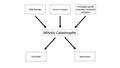 Mitotic Catastrophe Diagram version 2
 -
 Spindle chromosomes
 -
 Cyclin Expression
 -
 Normal and multipolar mitosis
 -
 Taxol
Taxol


