Sanger Brown: Difference between revisions
CSV import |
CSV import |
||
| Line 28: | Line 28: | ||
[[Category:Psychiatrists]] | [[Category:Psychiatrists]] | ||
[[Category:19th-century scientists]] | [[Category:19th-century scientists]] | ||
== Sanger Brown == | |||
<gallery> | |||
File:Sanger_Brown_(1852–1928).png|Sanger Brown (1852–1928) | |||
File:Grave_of_Sanger_Brown_(1852–1928)_at_Graceland_Cemetery,_Chicago.jpg|Grave of Sanger Brown (1852–1928) at Graceland Cemetery, Chicago | |||
</gallery> | |||
Latest revision as of 21:01, 25 February 2025
File:An investigation into the functions of the occipital and temporal lobes of the monkey's brain (IA b22289124).pdf Sanger Brown was a prominent figure in the field of psychiatry and neurology, known for his contributions to the understanding of the brain's structure and function. Born in the 19th century, Brown's work laid foundational knowledge that has influenced modern neuroscience and psychiatric practices.
Early Life and Education[edit]
Sanger Brown was born into a family with a strong emphasis on education and scientific inquiry. From a young age, he showed an aptitude for the sciences, particularly in biology and physiology. Pursuing higher education, Brown attended prestigious institutions where he studied medicine, focusing on the then-emerging fields of neurology and psychiatry.
Career[edit]
After completing his education, Sanger Brown dedicated his career to the study of the brain. He worked at several hospitals and research institutions, where he conducted experiments and clinical studies to explore the complexities of the human brain. Brown was particularly interested in the relationship between brain structures and mental disorders. His research contributed to early understandings of how different parts of the brain affect behavior, emotions, and cognitive functions.
Throughout his career, Brown published numerous papers and articles detailing his findings. He became a respected member of the scientific community, often speaking at conferences and contributing to academic discussions on neurology and psychiatry.
Contributions to Neuroscience[edit]
One of Sanger Brown's most significant contributions was his research on the cerebral cortex and its role in sensory processing and motor control. He conducted detailed studies on brain lesions and their impact on motor skills and sensory perception, which helped to map the functions of various cortical areas.
Brown also worked on understanding the neurological underpinnings of psychiatric disorders. He was among the first to suggest that certain mental illnesses could be attributed to physical abnormalities in the brain, a theory that was revolutionary at the time and paved the way for modern biological psychiatry.
Legacy[edit]
Sanger Brown's work has had a lasting impact on the fields of neurology and psychiatry. His research contributed to the development of new diagnostic and treatment methods for neurological and psychiatric conditions. Today, Brown is remembered as a pioneer who advanced our understanding of the brain's structure and function.
His legacy continues to inspire neuroscientists and psychiatrists, encouraging further research and exploration into the complex workings of the human brain.
See Also[edit]
Sanger Brown[edit]
-
 Sanger Brown (1852–1928)
 -
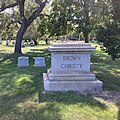 Grave of Sanger Brown (1852–1928) at Graceland Cemetery, Chicago
.png)
_at_Graceland_Cemetery,_Chicago.jpg)
