Morus rubra: Difference between revisions
CSV import |
CSV import |
||
| Line 25: | Line 25: | ||
{{Tree-stub}} | {{Tree-stub}} | ||
<gallery> | |||
File:MorusRubra9.jpg|Morus Rubra 9 | |||
File:Morus_rubra_250389.png|Morus rubra 250389 | |||
File:Morus_rubra_Nana_kz1.jpg|Morus rubra Nana kz1 | |||
File:MorusRubra2.jpg|Morus Rubra 2 | |||
</gallery> | |||
Latest revision as of 20:53, 25 February 2025
Morus rubra, commonly known as the Red Mulberry, is a species of mulberry native to eastern and central North America. It is found from Ontario, Minnesota, and Vermont south to southern Florida, and west as far as southeastern South Dakota, Nebraska, Kansas, and central Texas.
Description[edit]
Morus rubra is a deciduous tree, growing to 10–15 m tall, rarely 20 m. The leaves are 10–20 cm long by 6–12 cm broad - up to 23 cm long on vigorous young trees, downy on the underside, the upper surface rough with very short, stiff hairs. The flowers are 1–1.5 cm long; the fruit is 2–3 cm long, in wild trees often deep red, pink in some cultivated plants.
Habitat and Distribution[edit]
Morus rubra is found in rich woods, bottom lands, and along fencerows. It is often found in association with other hardwoods such as Quercus rubra and Acer rubrum. The species is threatened by the invasive species Morus alba (White Mulberry), which hybridizes with it.
Uses[edit]
The fruit of Morus rubra is edible and can be eaten raw or cooked. It is also used in pies, tarts, and wines. The wood is used for fence posts and furniture. The leaves are used as fodder for silkworms.
Conservation[edit]
Morus rubra is listed as a species of concern in several U.S. states. Efforts are being made to control the spread of Morus alba and to preserve pure stands of Morus rubra.
See also[edit]

-
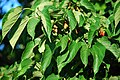 Morus Rubra 9
 -
 Morus rubra 250389
 -
 Morus rubra Nana kz1
 -
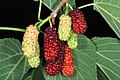 Morus Rubra 2


