Matnakash: Difference between revisions
CSV import |
CSV import |
||
| Line 27: | Line 27: | ||
{{food-stub}} | {{food-stub}} | ||
<gallery> | |||
File:Matnakash.JPG|Matnakash | |||
File:Matnakash.jpg|Matnakash | |||
File:Early_morning_bread_stop_(5051829793).jpg|Early morning bread stop | |||
File:Early_morning_bread_stop.jpg|Early morning bread stop | |||
File:Հաց.JPG|Հաց | |||
</gallery> | |||
Latest revision as of 12:00, 25 February 2025

Matnakash (Armenian: Մատնաքաշ) is a traditional Armenian leavened bread that is characterized by its unique, decorative patterns which are made by the fingers or a special tool before baking. The name 'Matnakash' literally translates to "finger draw" or "finger pull," reflecting the traditional method of preparation where the dough is artistically indented with fingers, creating its distinctive ridges and furrows.
History and Origin[edit]
Matnakash has a deep-rooted history in Armenia, where it has been a staple of the Armenian diet for centuries. It was traditionally made in tonirs, which are underground clay ovens. The bread's unique pattern was not only for aesthetics but also served practical purposes, such as allowing the bread to bake evenly. In the past, the design of the matnakash could signify the occasion for which it was baked, with different patterns used for daily consumption, religious ceremonies, and special celebrations.
Preparation[edit]
The preparation of Matnakash involves a series of steps that begin with the making of a yeast-based dough. The ingredients typically include flour, water, yeast, and salt, with some variations also including a small amount of sugar or oil to enrich the dough. After the dough is kneaded until smooth and elastic, it is left to rise until it doubles in size.
Once risen, the dough is divided and shaped into balls. Each ball is then rolled out and stretched by hand to create a thick, oval-shaped base. The central part of the dough is then indented with fingers or a special tool, leaving the edges thicker to form a characteristic border. This technique not only decorates the bread but also helps in creating its unique texture, with a soft interior and a slightly crusty exterior.
The shaped dough is left to rise again before being baked in a hot oven until it achieves a golden-brown color. The high temperature is crucial for creating the bread's signature crust and ensuring that the interior is fully cooked.
Cultural Significance[edit]
Matnakash holds a special place in Armenian culture, symbolizing the sun and fertility with its round shape and the patterns resembling the rays of the sun. It is a common feature on the Armenian table, served during meals, and is particularly prominent during religious and festive occasions. The bread is often paired with cheese, herbs, or soup, making it an integral part of Armenian culinary traditions.
Modern Variations[edit]
While the traditional method of making Matnakash remains popular in Armenia and among Armenian communities worldwide, there are also modern variations of the bread. Some bakers experiment with different types of flour, such as whole wheat or rye, to create variations in texture and flavor. Additionally, contemporary versions of Matnakash may include toppings or fillings, such as seeds, nuts, or herbs, to add an extra layer of taste.
See Also[edit]

-
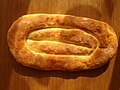 Matnakash
 -
 Matnakash
 -
 Early morning bread stop
 -
 Early morning bread stop
 -
 Հաց
Հաց

.jpg)


