Smoked meat: Difference between revisions
CSV import Tags: mobile edit mobile web edit |
CSV import |
||
| Line 54: | Line 54: | ||
[[Category:Food preservation]] | [[Category:Food preservation]] | ||
[[Category:Cooking techniques]] | [[Category:Cooking techniques]] | ||
== Smoked_meat == | |||
<gallery> | |||
File:O_Piornedo,_Donís,_Cervantes_10.jpg|O Piornedo, Donís, Cervantes | |||
File:Chambre_de_boucanage.jpg|Chambre de boucanage | |||
File:Smoking_fish_near_Dakar,_Sénégal_(west_Africa)_(2290515874).jpg|Smoking fish near Dakar, Sénégal | |||
File:Smoking_Meat.jpg|Smoking Meat | |||
File:American_Bacon.jpg|American Bacon | |||
File:Country_ham.jpg|Country ham | |||
File:FMIB_38894_Smoking_Finnan_Haddie.jpeg|Smoking Finnan Haddie | |||
File:枯本背節_(8517415760).jpg|枯本背節 | |||
</gallery> | |||
Latest revision as of 11:47, 25 February 2025
A comprehensive overview of smoked meat, its preparation, types, and cultural significance
Overview[edit]
Smoked meat is a method of preparing red meat, white meat, and seafood which originated in prehistory. It is one of the oldest food preservation techniques, combining the effects of salting and smoking to extend the shelf life of perishable food items. The process involves exposing the meat to smoke from burning or smoldering materials, typically wood.
History[edit]
The practice of smoking meat dates back thousands of years. Early humans discovered that hanging meat over a fire not only cooked it but also preserved it. This was particularly important before the advent of refrigeration. Over time, different cultures developed their own methods and flavors, leading to a rich diversity of smoked meat traditions around the world.
Preparation[edit]
The preparation of smoked meat involves several steps:
Curing[edit]
Before smoking, meat is often cured with salt, sugar, and spices. This process draws out moisture and adds flavor. Curing can be done using a dry rub or a wet brine.
Smoking[edit]
The smoking process can be hot or cold:
- Hot smoking cooks the meat while infusing it with smoke flavor. It is done at temperatures of 52 to 80 °C (126 to 176 °F).
- Cold smoking imparts flavor without cooking the meat, typically done at temperatures below 30 °C (86 °F).
Wood Selection[edit]
The type of wood used in smoking greatly affects the flavor of the meat. Common woods include hickory, mesquite, apple, and cherry. Each type of wood imparts a unique flavor profile.
Types of Smoked Meat[edit]
Pastrami[edit]
Pastrami is a popular smoked meat, particularly in Jewish cuisine. It is typically made from beef brisket, which is cured, seasoned, smoked, and steamed.
Bacon[edit]
Bacon is a type of smoked pork belly that is cured and then smoked. It is a staple in many Western diets.
Smoked Salmon[edit]
Smoked salmon is a delicacy made by curing and smoking salmon. It is often served on bagels with cream cheese.
Barbecue[edit]
Barbecue involves smoking meat, such as ribs or brisket, over a long period at low temperatures. It is a popular cooking method in the Southern United States.
Cultural Significance[edit]
Smoked meat holds cultural significance in many regions:
- In Montreal, smoked meat sandwiches are a culinary icon.
- In the Southern United States, barbecue is not just a cooking method but a social event.
- In Scandinavia, smoked fish is a traditional food, often served during holidays.
Health Considerations[edit]
While smoked meat is flavorful, it is important to consume it in moderation. The smoking process can produce polycyclic aromatic hydrocarbons (PAHs) and nitrosamines, which are potential carcinogens. Choosing lean cuts and using modern smoking techniques can reduce these risks.
Related Pages[edit]
Smoked_meat[edit]
-
 O Piornedo, Donís, Cervantes
 -
 Chambre de boucanage
 -
 Smoking fish near Dakar, Sénégal
 -
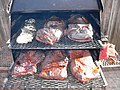 Smoking Meat
 -
 American Bacon
 -
 Country ham
 -
 Smoking Finnan Haddie
 -
 枯本背節
枯本背節


_(2290515874).jpg)


.jpg)
