Mash ingredients: Difference between revisions
CSV import Tags: mobile edit mobile web edit |
CSV import Tags: mobile edit mobile web edit |
||
| Line 22: | Line 22: | ||
[[Category:Distilled drinks]] | [[Category:Distilled drinks]] | ||
{{food-stub}} | {{food-stub}} | ||
<gallery> | |||
File:Milled_Malted_Barley.JPG|Milled Malted Barley | |||
File:Crystal_Malt_80L.jpg|Crystal Malt 80L | |||
</gallery> | |||
Latest revision as of 11:28, 25 February 2025
Mash ingredients are the materials used in the mashing process that occurs in the production of various beverages and foods such as beer, whiskey, and bread. The primary ingredients are typically a starch source such as grains and water. Other ingredients may include enzymes, yeast, and various flavorings.
Starch Sources[edit]
The most common starch source used in mash is malted grain. Malted grain is grain that has been soaked in water, allowed to germinate, and then dried in a kiln. This process develops the enzymes required to modify the grain's starches into sugars, including monosaccharides such as glucose, disaccharides such as maltose and maltotriose, and unfermentable sugars such as dextrins.
Other starch sources used in mash include corn, rice, and sugar. These ingredients are often used in the production of light beer and distilled spirits.
Water[edit]
Water is a critical ingredient in the mashing process. It is used to steep the grains and convert the grain starches into fermentable sugars. The quality of the water used can significantly affect the taste of the final product. Many breweries use specific types of water, such as hard water for pale ales and soft water for lagers.
Enzymes[edit]
Enzymes play a crucial role in the mashing process. They are responsible for breaking down the starches in the grain into sugars that can be fermented. The two main types of enzymes used in mashing are alpha-amylase and beta-amylase. Alpha-amylase breaks down long-chain carbohydrates, ultimately yielding maltotriose and maltose from amylose, or glucose, maltose and "limit dextrin" from amylopectin. Beta-amylase breaks down the remaining dextrins into maltose.
Yeast[edit]
Yeast is added to the mash after the mashing process is complete. The yeast ferments the sugars released during mashing, producing alcohol and carbon dioxide. The type of yeast used can significantly affect the flavor and aroma of the final product.
Flavorings[edit]
Various flavorings may be added to the mash, depending on the desired final product. These can include hops for beer, botanicals for gin, and fruits for fruit beers and wines.

-
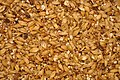 Milled Malted Barley
 -
 Crystal Malt 80L


