Baharat: Difference between revisions
CSV import Tags: mobile edit mobile web edit |
CSV import |
||
| Line 22: | Line 22: | ||
[[Category:Middle Eastern cuisine]] | [[Category:Middle Eastern cuisine]] | ||
{{food-stub}} | {{food-stub}} | ||
<gallery> | |||
File:Baharat.png|Baharat | |||
File:Gulfbaharatingredients.gif|Gulf Baharat Ingredients | |||
</gallery> | |||
Latest revision as of 11:22, 25 February 2025
Baharat is a spice blend commonly used in Middle Eastern cuisine. The word "baharat" literally translates to "spices" in Arabic, and it is a staple ingredient in many traditional dishes from the region.
Composition[edit]
Baharat is a blend of several different spices, the exact composition of which can vary depending on the region and personal preference. However, the most common ingredients include black pepper, coriander seeds, cinnamon, cloves, cumin, cardamom, nutmeg, and paprika. Some variations may also include dried mint, dried lime, or saffron.
Usage[edit]
Baharat is used to season a variety of dishes, including meat, fish, poultry, rice, and vegetables. It is often used as a rub for lamb, fish, and chicken, or mixed into marinades. In addition to its use in cooking, baharat is sometimes sprinkled on food as a condiment.
Regional Variations[edit]
While the basic ingredients of baharat are fairly consistent, there are regional variations in the blend. For example, in Turkey, baharat may include mint and dried lime, while in Tunisia, the blend is likely to include dried roses. In the Persian Gulf, loomi (dried black lime) and saffron are often added to the mix.
Preparation[edit]
Baharat is typically prepared by grinding the spices together in a spice grinder or mortar and pestle. The spices can be used whole or pre-ground, but many cooks prefer to grind their own to ensure the freshest flavor. Once the spices are ground, they are mixed together to create the final blend.
See Also[edit]

-
 Baharat
 -
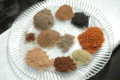 Gulf Baharat Ingredients


