Sexual dimorphism: Difference between revisions
CSV import |
CSV import |
||
| Line 30: | Line 30: | ||
{{stub}} | {{stub}} | ||
<gallery> | |||
File:Pair_of_mandarin_ducks.jpg|Pair of mandarin ducks | |||
File:Peacock_courting_peahen.jpg|Peacock courting peahen | |||
File:Anas_platyrhynchos_male_female_quadrat.jpg|Anas platyrhynchos male female | |||
File:Orgyia_antiqua_MHNT.CUT.2012.0.356.Gières.jpg|Orgyia antiqua | |||
File:Colias_dimera_copulating.jpg|Colias dimera copulating | |||
File:Male_and_female_A._appensa.jpg|Male and female A. appensa | |||
File:Hammock_Spiders_(Pityohyphantes).jpg|Hammock Spiders (Pityohyphantes) | |||
File:Mississippi_map_turtles_(Graptemys_pseudogeographica_kohni)_female_&_male.jpg|Mississippi map turtles (Graptemys pseudogeographica kohni) female & male | |||
File:Golden-shouldered_Parrot_0A2A7450.jpg|Golden-shouldered Parrot | |||
File:Eclectus_roratus-20030511.jpg|Eclectus roratus | |||
File:Male_and_female_black_casqued_hornbill_skeletons.jpg|Male and female black casqued hornbill skeletons | |||
File:Male_and_female_Mirounga_angustirostris_2.jpg|Male and female Mirounga angustirostris | |||
</gallery> | |||
Latest revision as of 21:23, 23 February 2025
Sexual dimorphism is a term used in biology and physical anthropology to describe the differences in appearance between males and females of the same species. These differences can be physical (such as size or color), behavioral (such as courtship rituals), or physiological (such as lifespan or disease susceptibility).
Overview[edit]
Sexual dimorphism is a widespread phenomenon in nature and can be observed in many different species, including mammals, birds, reptiles, insects, and plants. The degree of sexual dimorphism can vary greatly among species. In some cases, the differences between males and females are subtle and difficult to detect. In other cases, the differences are dramatic and easily noticeable.
Causes[edit]
The primary cause of sexual dimorphism is sexual selection, a type of natural selection in which individuals with certain traits are more likely to attract mates and reproduce. Over time, these traits become more common in the population, leading to noticeable differences between males and females.
Examples[edit]
One of the most well-known examples of sexual dimorphism is the size difference between male and female lions. Male lions are significantly larger than females and have a distinctive mane, which is absent in females. Another example is the color difference between male and female peafowls. Male peafowls (peacocks) have a colorful and elaborate tail display, while females (peahens) are more drab in color.
Implications[edit]
The study of sexual dimorphism has important implications for our understanding of evolution, animal behavior, and human health. For example, it can help us understand why certain traits have evolved in a particular way, or why certain diseases are more common in one sex than the other.
See also[edit]
 | |
|---|---|
 |
 |
-
 Pair of mandarin ducks
 -
 Peacock courting peahen
 -
 Anas platyrhynchos male female
 -
 Orgyia antiqua
 -
 Colias dimera copulating
 -
 Male and female A. appensa
 -
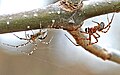 Hammock Spiders (Pityohyphantes)
 -
 Mississippi map turtles (Graptemys pseudogeographica kohni) female & male
 -
 Golden-shouldered Parrot
 -
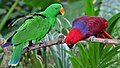 Eclectus roratus
 -
 Male and female black casqued hornbill skeletons
 -
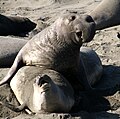 Male and female Mirounga angustirostris


.jpg)
_female_%26_male.jpg)


